FASHN is one of the most polished try-on platforms on the market — fast, developer-friendly, with video and a well-designed studio. CatalogX is built for a narrower job: making sure the garment in your listing photo is your garment, construction and all. If you sell sarees, kurtis, or lehengas, that difference decides everything.
Searching for a FASHN alternative usually means one of two things. Either you want a broader creative platform — API access, video, editing, model swaps — or you ran a garment through a try-on tool and the output wasn't your garment anymore. This page is for the second group.
In August 2026 we paid for FASHN and ran five real generations through their pipelines — because they are the reference point in this category and we wanted to know exactly where we stand. The honest summary: FASHN is excellent at generating fashion imagery. CatalogX is better at reproducing a specific garment — especially South Asian ethnic wear, where construction details like side slits, churidar pairing, pleats, and hem length are the product. The rest of this page unpacks that claim, concedes where FASHN is genuinely ahead, and ends with a test you can run yourself for free.
Let's start with what FASHN gets right, because it's a lot. FASHN builds its own try-on models, publishes research, and has open-sourced parts of its stack — real engineering depth, not marketing. It shows in the product:
FASHN's pricing (last checked September 9, 2026): Basic at $19/month for 200 credits, Pro at $49/month for 750 credits plus 50 daily, and Agency at $99/month for 1,500 credits plus 100 daily, with annual billing at $190/$490/$990 and top-ups at $0.10 per credit. For a team producing high volumes of Western apparel imagery daily, that is a well-constructed ladder.
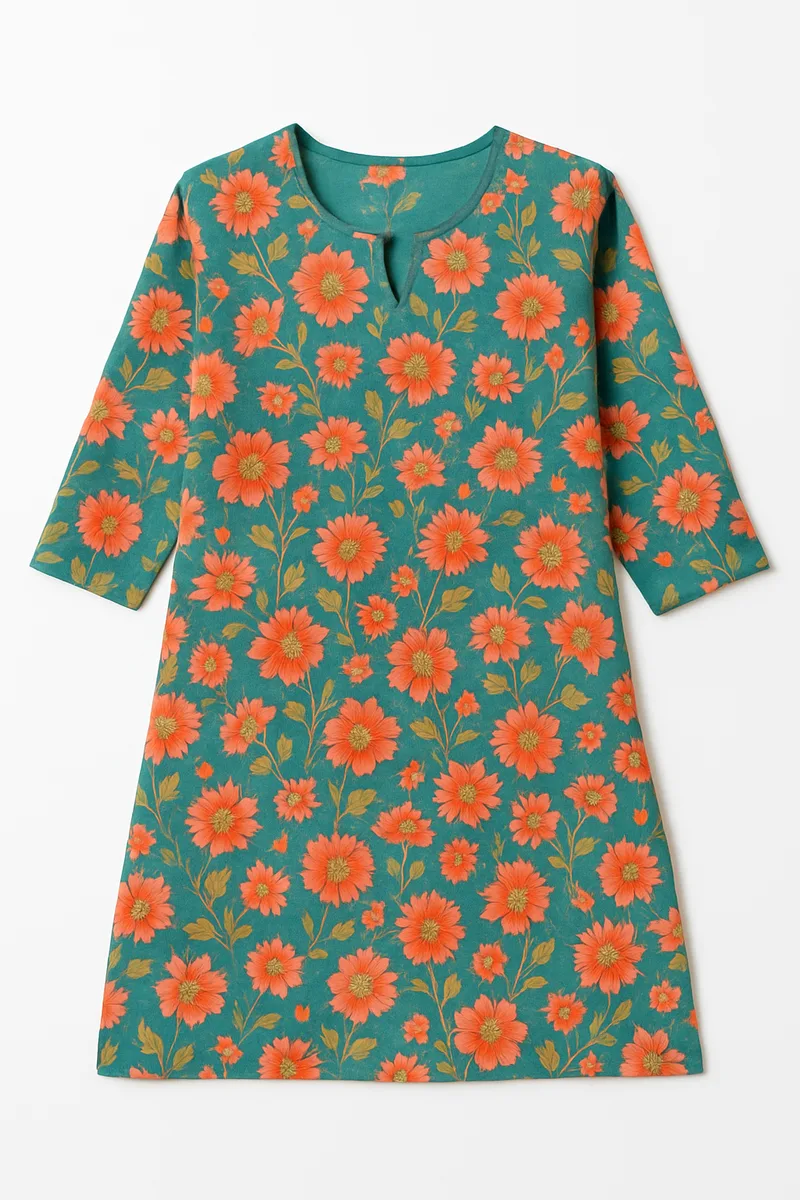
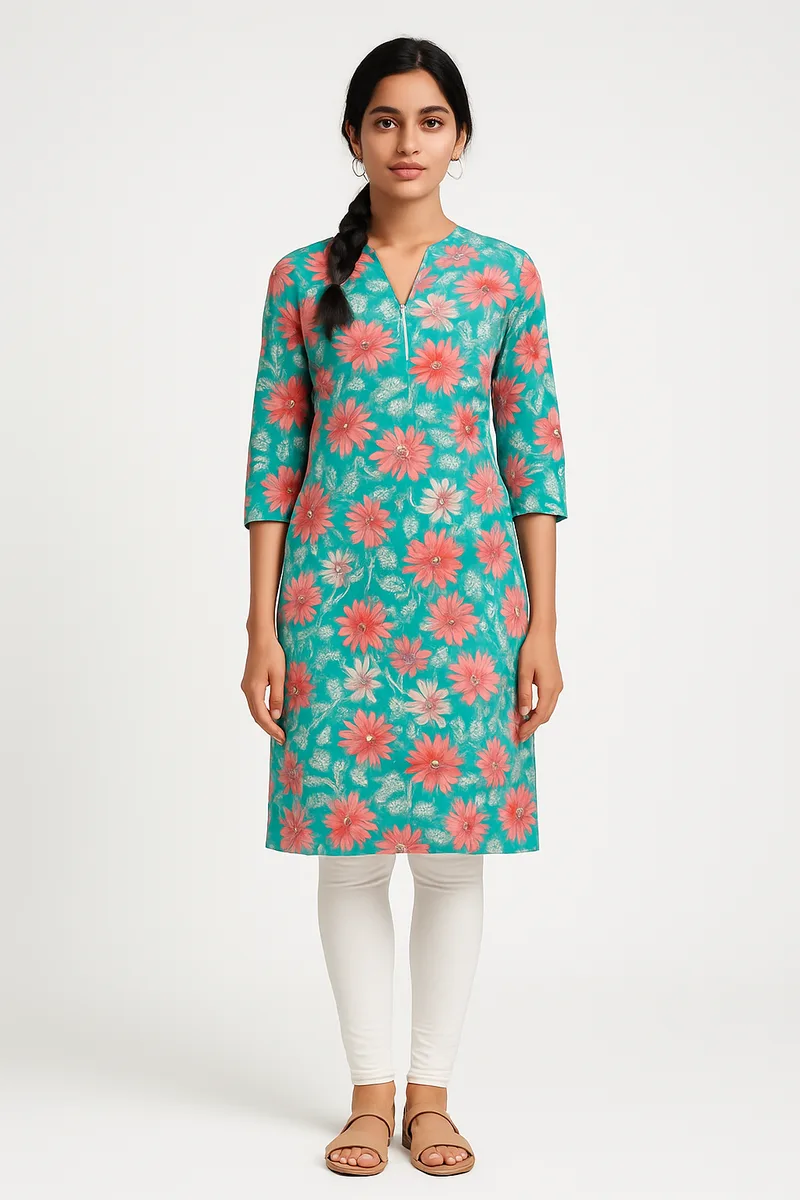
CatalogX starts from a different premise: the seller's photo is a contract. A buyer on Etsy or Amazon will receive the exact garment in your listing, so the model photo must show that exact garment — same neckline, same buttons, same slits, same hem length. Four things follow:
A CatalogX before/after from our own library — shown to illustrate what "the garment survives" means. This is not an image from our FASHN test; that test is described in text below.
Feature checklists hide the real difference. Here is how the two tools behave on the questions an ethnic-wear seller actually asks.
| CatalogX | FASHN | |
|---|---|---|
| Treats your garment as | A product to reproduce exactly, with construction rules per garment type | An input to a styled generation — details often preserved, category sometimes reinterpreted |
| Kurti / saree drape accuracy | Purpose-built: slits, churidar pairing, pleat & pallu direction, dupatta styling | Strong in its general pipeline; its dedicated Try-On rendered a kurti as a maxi dress in our paid test (Aug 2026) |
| Same model across your catalog | Reuse any of 40+ models across every listing; upload your own model photos on all plans, including free | Consistent-model and face-reference features exist; uploading your own model into Try-On requires a subscription |
| Hem length fidelity | Hem length is one of the enforced construction rules — a knee-length kurti stays knee-length | Not reliably enforced in Try-On: our test kurti came back floor-length |
| Right for | Sellers of South Asian & ethnic wear who need marketplace-ready photos of the exact garment they ship | Teams and developers who want fast, high-volume fashion imagery, an API, editing, and video in one studio |
| Wrong for | Video try-on (we don't do it), or developers needing API access below our $49.99 Business plan | Ethnic-wear catalogs where the garment's category and construction must survive the try-on unchanged |
FASHN is a trademark of its respective owner. CatalogX is not affiliated with FASHN. FASHN observations come from our own paid test account (August 2026) and FASHN's public pricing page, last checked September 9, 2026. Features and pricing change — see fashn.ai for current details.
Per-credit price at volume. Do the arithmetic honestly: FASHN's $19 Basic includes 200 credits (about $0.095 per image); CatalogX's $9.99 Starter includes 20 (about $0.50 per image). Credit for credit, FASHN is roughly five times cheaper, and the daily credits on their Pro and Agency tiers stretch that further. FASHN builds and runs its own models, which is why they can price this way. If you generate hundreds of Western-apparel images a month and they come out usable, FASHN's spreadsheet wins.
Breadth of tooling. Video try-on, instruction-based editing, model swap, face swap, upscaling, reframing, and a browsable asset library — all in one studio, all one credit per operation. FASHN is a creative platform; CatalogX is a catalog tool with a tighter set of jobs.
The developer path. If try-on is a feature you're building into your own product, FASHN's API-first posture, generation IDs, and published research make it the safer bet. CatalogX offers API access on the Business plan, but it is not the center of our product the way it is of theirs.
The kurti test. Here is the result our whole positioning rests on, from our own paid test of FASHN in August 2026. We took a maroon kurti — mandarin collar, three-button gold placket, 3/4 sleeves, side slits — and ran it through FASHN's dedicated Try-On pipeline onto one of their models. The output preserved the collar, placket, button count, and colour faithfully. But the garment came back as a floor-length Western jersey maxi dress: no side slits, no churidar, draped over the ankle boots the model was already wearing. The details survived; the garment category did not. A buyer shown that photo would be ordering a dress and receiving a kurti.
What makes this interesting rather than a cheap shot: FASHN's general Product to Model pipeline handled the same kurti well in a separate run — it even added a correct churidar, unprompted. Their platform clearly understands Indian garments at some level. But the dedicated try-on model — the tool a seller would actually use to put a garment on a chosen model — misread the category entirely. That is precisely the layer where CatalogX invests: our try-on encodes ethnic-wear construction rules, so a kurti's slits, length, and churidar pairing are enforced, not inferred. We describe this test in text rather than screenshots deliberately; their output isn't ours to republish, and the test is easy to reproduce yourself.
Entry price and marketplace workflow. CatalogX's paid plans start at $9.99/month against FASHN's $19 minimum, and the free tier needs no card. Because we assume the output is destined for a listing rather than a campaign, export presets for Amazon, Etsy, eBay, Poshmark, Depop, and TikTok Shop are built in — including Amazon's standing-model MAIN-image rule for adult apparel.
Your own models, on every plan. On FASHN's free plan, uploading your own model image into Try-On is subscription-gated — free users pick from FASHN's curated models. If your brand is built on a consistent model wearing your collection, CatalogX supports your own model photos on every plan, free included.
Comparison pages — ours included — are written by one of the vendors. So run the test we ran, on your own garment, for free:
Twenty minutes, zero dollars, and you'll know more than any comparison page can tell you. If FASHN's output nails your garment, use FASHN — their per-credit price at volume is genuinely better. If the garment comes back as something you don't sell, you've found the difference this page is about.
Yes. FASHN is a polished, fast platform: generations complete in roughly 25–30 seconds at a flat 1 credit per operation, there is a developer API, instruction-based editing, image-to-video, and a well-designed studio workflow. Where it struggled in our paid test (August 2026) was South Asian ethnic wear in its dedicated Try-On pipeline, which rendered a kurti as a Western maxi dress.
As of our last check on September 9, 2026, FASHN lists Basic at $19/month for 200 credits, Pro at $49/month for 750 credits plus 50 daily credits, and Agency at $99/month for 1,500 credits plus 100 daily credits, with annual billing at $190/$490/$990 and top-ups at $0.10 per credit (100-credit minimum). See their site for current pricing.
For sellers of sarees, kurtis, lehengas, and other South Asian garments, CatalogX is purpose-built: its try-on encodes ethnic-wear construction rules — side slits, churidar pairing, pleat and pallu direction, dupatta styling, hem length — that generic try-on models often miss. Plans start free (5 credits, no card) and paid plans start at $9.99/month.
Mixed, based on our own paid test in August 2026. FASHN's general Product to Model pipeline rendered a kurti impressively, even adding a correct churidar. But its dedicated Try-On pipeline turned the same kurti into a floor-length Western jersey maxi dress — no side slits, no churidar. Details like collar and buttons were preserved; the garment category was not.
It depends how you count. On entry price, yes: CatalogX Starter is $9.99/month versus FASHN's $19/month minimum, and CatalogX has a free tier with 5 credits and no card. On a per-credit basis, no: FASHN's $19 Basic includes 200 credits, while CatalogX Starter includes 20 — FASHN is meaningfully cheaper per image at volume. If your bottleneck is garment accuracy rather than image volume, cheap credits spent on unusable outputs are not a saving.
Yes. Both have free tiers — CatalogX gives 5 credits with no card required. That is exactly how we recommend deciding: run your single hardest garment (a saree with a heavy border, a kurti with side slits, a lehenga with real flare) through both free tiers and compare the outputs against the garment photo detail by detail.
Choose FASHN if you need a broad creative platform: an API to build on, video try-on, instruction-based editing, and hundreds of Western-apparel images a month at the lowest per-credit price. It is fast, well-built, and backed by real research.
Choose CatalogX if you sell South Asian or other construction-heavy ethnic wear and the photo must show the exact garment the buyer receives. Our try-on enforces the slits, drape, pairing, and hem length that define these garments, our exports comply with Amazon's and Etsy's image rules, and our plans start at a price a solo seller can justify before the first sale. Different tools, different jobs — and for the ethnic-wear job, the kurti test is the tiebreaker. Run it.
Upload your hardest garment and see it on a model in about 30 seconds — slits, drape, and hem length intact. 5 free credits, no card required.