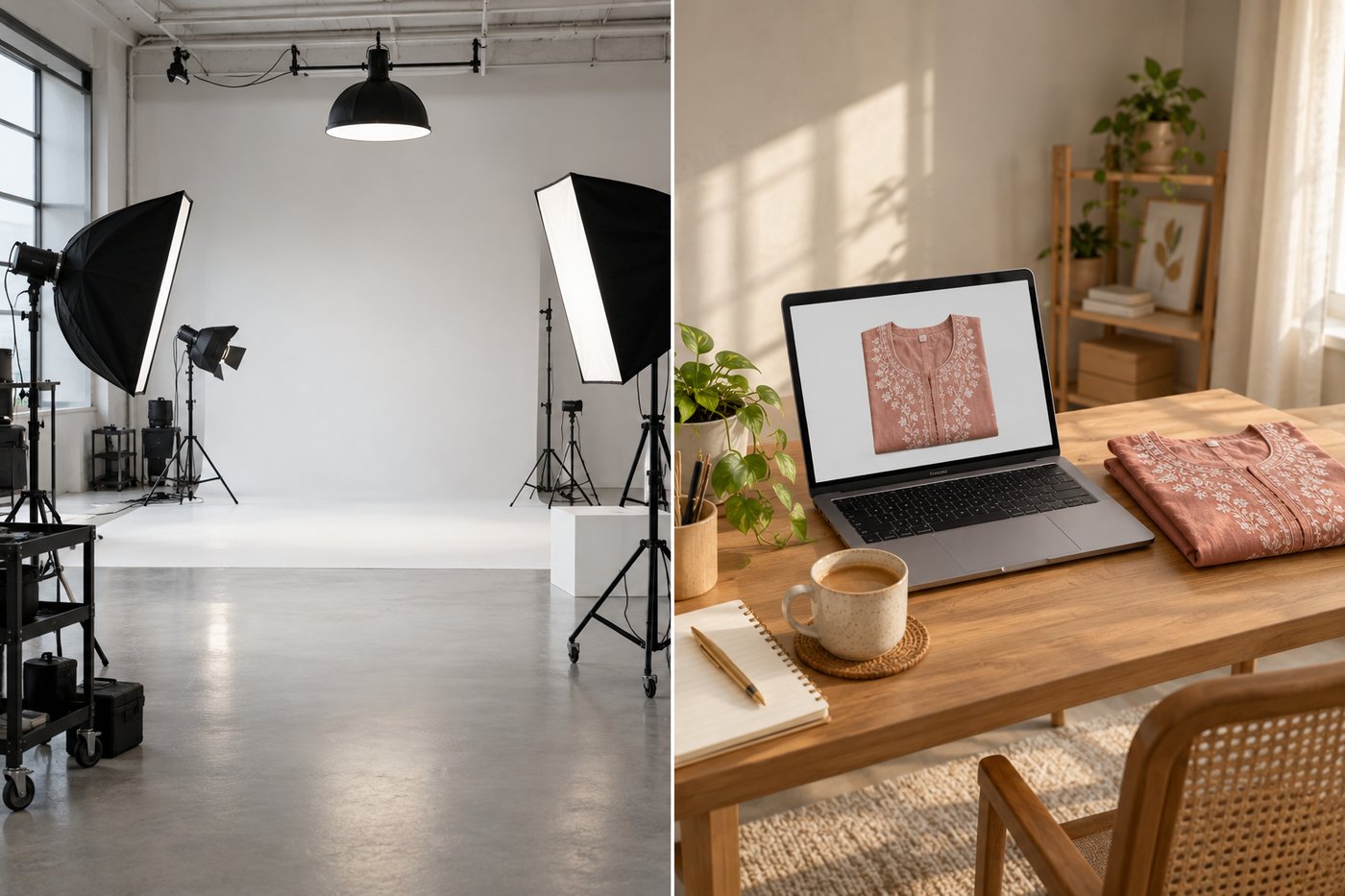
A small on-model product shoot in the US costs $1,500-5,000 per day in 2026 and yields 20-40 usable images — an effective $50-150 per finished photo. AI-generated model photos price the same deliverable in single-digit dollars or less per image, with no booking, no studio and no reshoot risk. For small clothing brands, that gap is no longer a rounding error; it is the photography budget itself.
If you run a small clothing label — a boutique line, a print-on-demand brand, or an ethnic wear shop serving diaspora customers — this article breaks down where every dollar of a traditional shoot goes, what the AI alternative actually costs, and where each one genuinely wins. Rates reflect 2026 pricing for small commercial shoots in mid-size and major US markets.
What a US Product Photoshoot Costs, Line by Line
Every on-model shoot has the same cost centers: photographer, model, location, styling, and post-production. Here is what small brands are actually quoted:
| Cost Component | Budget | Mid-Range | Premium |
|---|---|---|---|
| Photographer (per day) | $500 - 800 | $800 - 1,500 | $1,500 - 2,500+ |
| Model (per day) | $300 - 500 | $500 - 800 | $800 - 1,200+ |
| Studio rental (per hour) | $75 - 125 | $125 - 175 | $175 - 250+ |
| Hair and makeup | $150 - 250 | $250 - 350 | $350 - 400+ |
| Retouching (per image) | $10 - 15 | $15 - 25 | $25 - 40+ |
| Typical day total | $1,500 - 2,500 | $2,500 - 4,000 | $4,000 - 5,000+ |
Divide a mid-range day by its 20-40 usable images and you get the number that matters: roughly $50-150 per finished photo. And the sticker price understates the real cost:
- Scheduling lead time: aligning a photographer, model and studio takes two to four weeks. Inventory sits unlisted while you wait.
- Minimums: most photographers book half-day minimums. Shooting five new arrivals costs nearly the same as shooting twenty, which punishes exactly the small drops most independent brands run.
- Reshoots: a marketplace rejection, a lighting inconsistency, or a colorway added after the shoot means paying the day rate again — or listing with a hole in your gallery.
- Specialist gaps: if your line includes non-Western garments, finding a US model and photographer who can drape and style a saree or style a kurta set correctly narrows the talent pool and raises the rate.
None of this is photographers overcharging. Skilled labor in a US market simply costs this much — which is the whole problem for a brand whose products retail at $40-120.
What the AI Alternative Costs
AI virtual try-on replaces the shoot day with an upload: you photograph the garment flat (or use your supplier's catalog shot), pick a model and scene, and the tool generates a photorealistic on-model image in about 30 seconds. There is no booking, no studio, no retouching pass — the lighting and background come out consistent by construction.
CatalogX prices this per image, in credits. You start with 5 free credits — no card required — which is enough to test the output against your current photos with your own garments, and paid plans put each additional image at a small fraction of the $50-150 a studio image works out to. Current plans and per-image rates are on the pricing page.
The volume math is where the difference compounds. Refreshing a 60-listing store with two new photos each is 120 images: a $6,000-18,000 line item at studio rates, versus an AI bill that fits inside what one studio hour would have cost. Colorway variants — the same dress in five colors — regenerate from one photo at one credit each, instead of five more outfit changes on a paid shoot day.
Upload a garment photo and see the AI model shot next to your current listing photo. 5 free credits, no card needed.
Try Free Now →
Side by Side: The Numbers That Decide It
| Factor | Studio Photoshoot (US) | AI Model Photos |
|---|---|---|
| Cost per finished image | $50 - 150 | Single-digit dollars or less |
| Booking to delivery | 2 - 4 weeks | Same day |
| Minimum spend | $750+ (half-day minimum) | $0 (free credits to start) |
| New colorway | Another shoot or gap in gallery | One credit, identical pose and lighting |
| Consistency across catalog | Depends on rebooking same team | Same model and scene on demand |
| Fix a rejected image | Reshoot | Regenerate in 30 seconds |
Where the Studio Still Wins
An honest comparison has a second column with real entries. Book a traditional shoot when:
- The image is the brand. Campaign heroes, homepage banners and lookbooks benefit from real creative direction, real locations and the editorial spark a photographer brings. AI photos are listing photos; campaigns are storytelling.
- You need video. Fabric movement, walking shots, and social reels still require a real model in a real room.
- Macro texture is the selling point. If a $400 hand-finished piece sells on thread-level detail, real macro photography of that detail belongs in the gallery — ideally alongside AI on-model shots, not instead of them.
The pattern among cost-efficient small brands in 2026 is hybrid: AI for the volume listing work — which is 80-90% of all images a store needs — and one or two real shoots a year for campaign material. The budget those brands used to burn on routine listing photography now buys inventory and ads. Our deeper dive into why product photography costs what it does explains which cost centers AI removes and which it cannot.
A Note for Ethnic and Fusion Wear Brands
If your brand sells South Asian or fusion wear to diaspora customers in the US or UK, the studio math above is worse for you and the AI option needs one extra filter. Worse, because models and stylists who can handle a saree drape or a lehenga correctly are scarce outside a few metro markets and price accordingly. And the extra filter: most AI try-on tools are trained on Western fashion and will quietly redraw a kurti into a shift dress. Use a tool that treats these garments as first-class types — CatalogX renders saree pleats and pallu, lehenga flare and dupatta fall as constructed, on a model library that includes South Asian models. If you sell on Etsy, our guide to selling Indian ethnic wear on Etsy from the US or UK walks through the full listing workflow.
The Bottom Line
At $50-150 per studio image, photography is one of the largest per-SKU costs a small US clothing brand carries — often larger than the garment's landed cost. AI model photos move that line item to nearly zero for routine listings while matching marketplace quality standards. The brands that keep paying studio rates for standard listing photos are not buying better photos; they are buying the same photos at fifty times the price.
The sensible next step costs nothing: generate a few images with your own garments, put them next to your current photos, and decide with your own eyes.