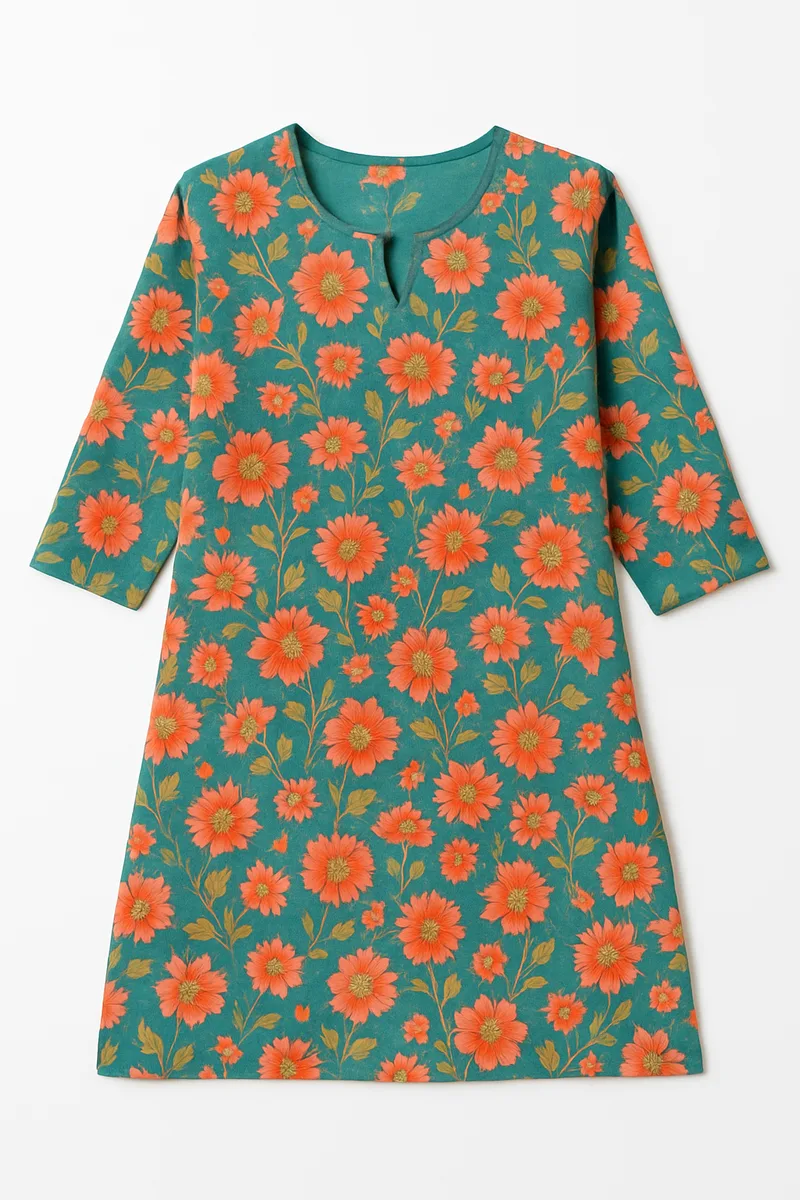
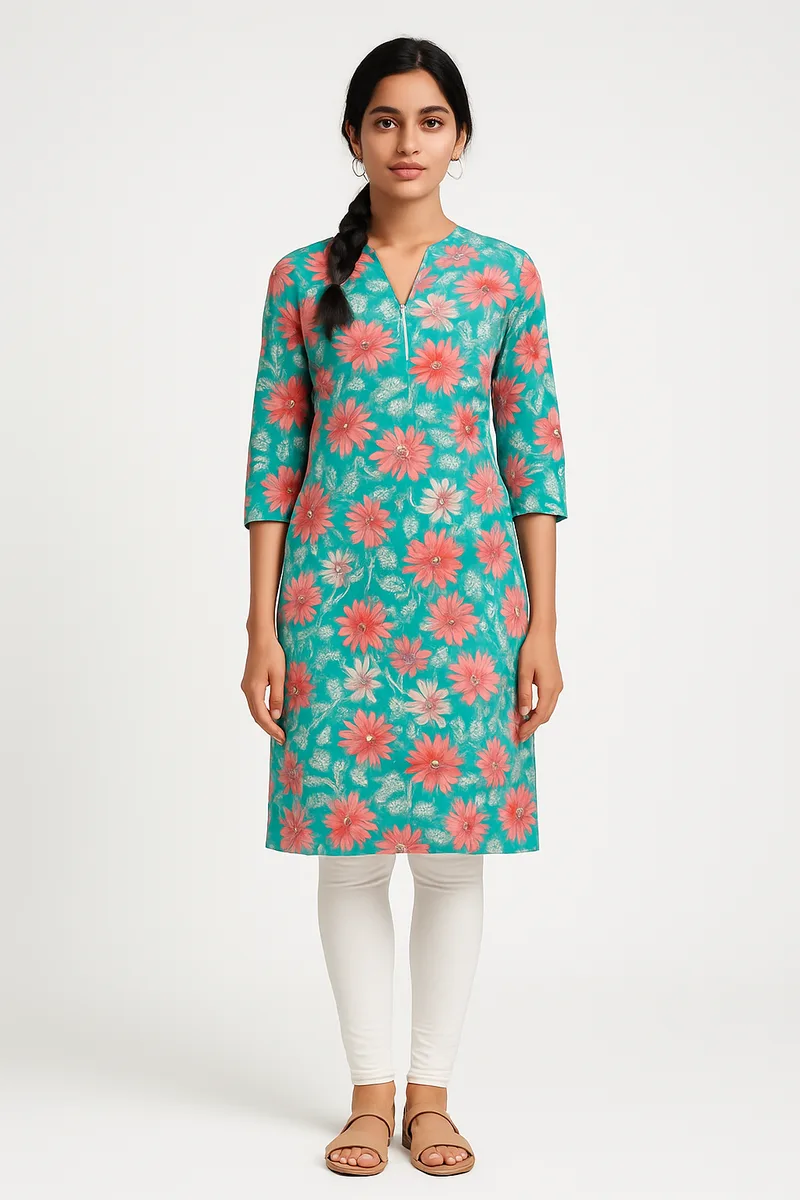
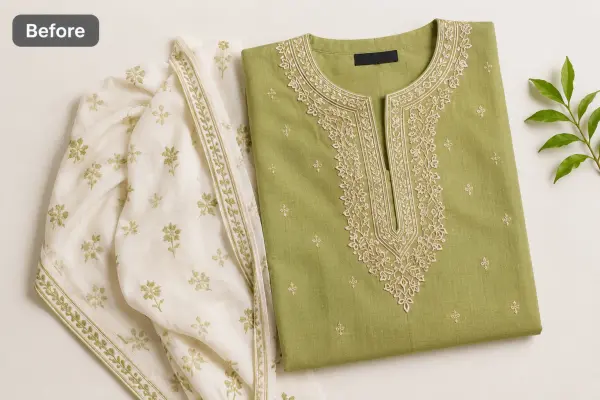
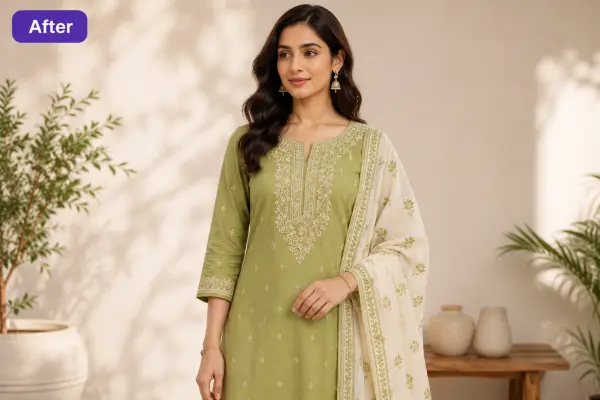
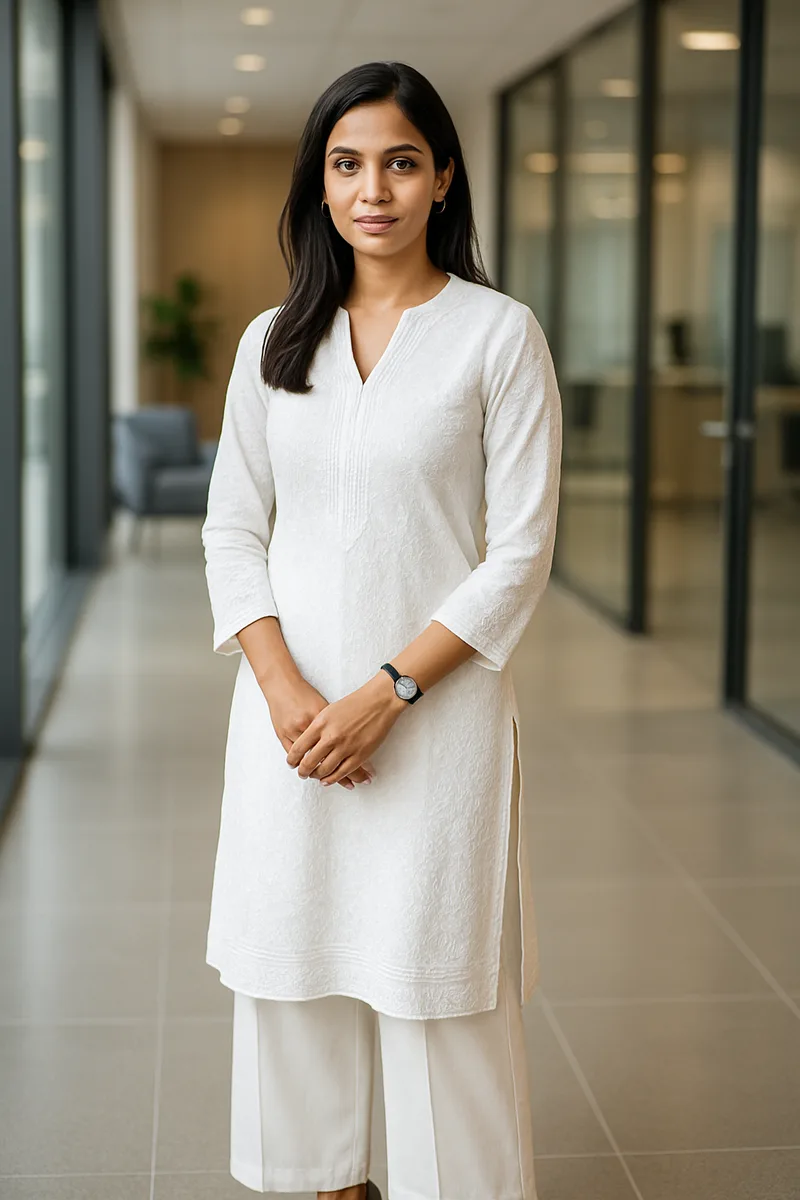
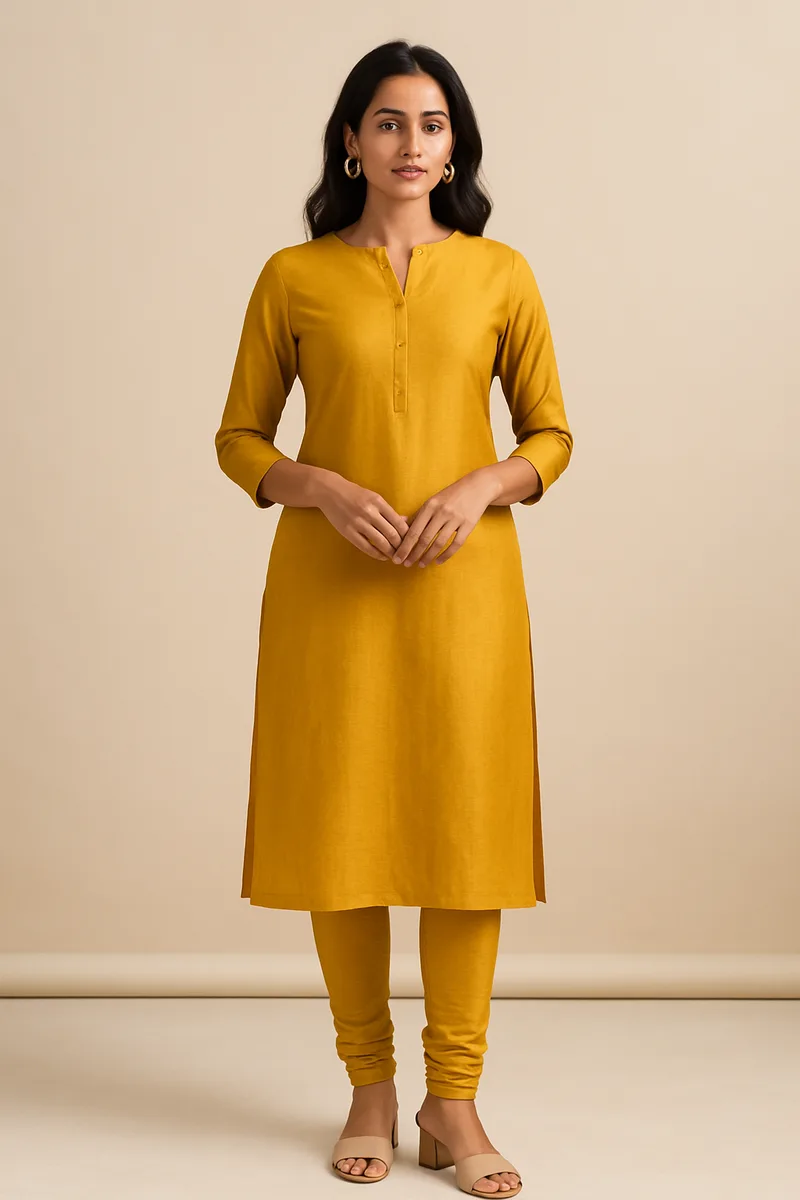
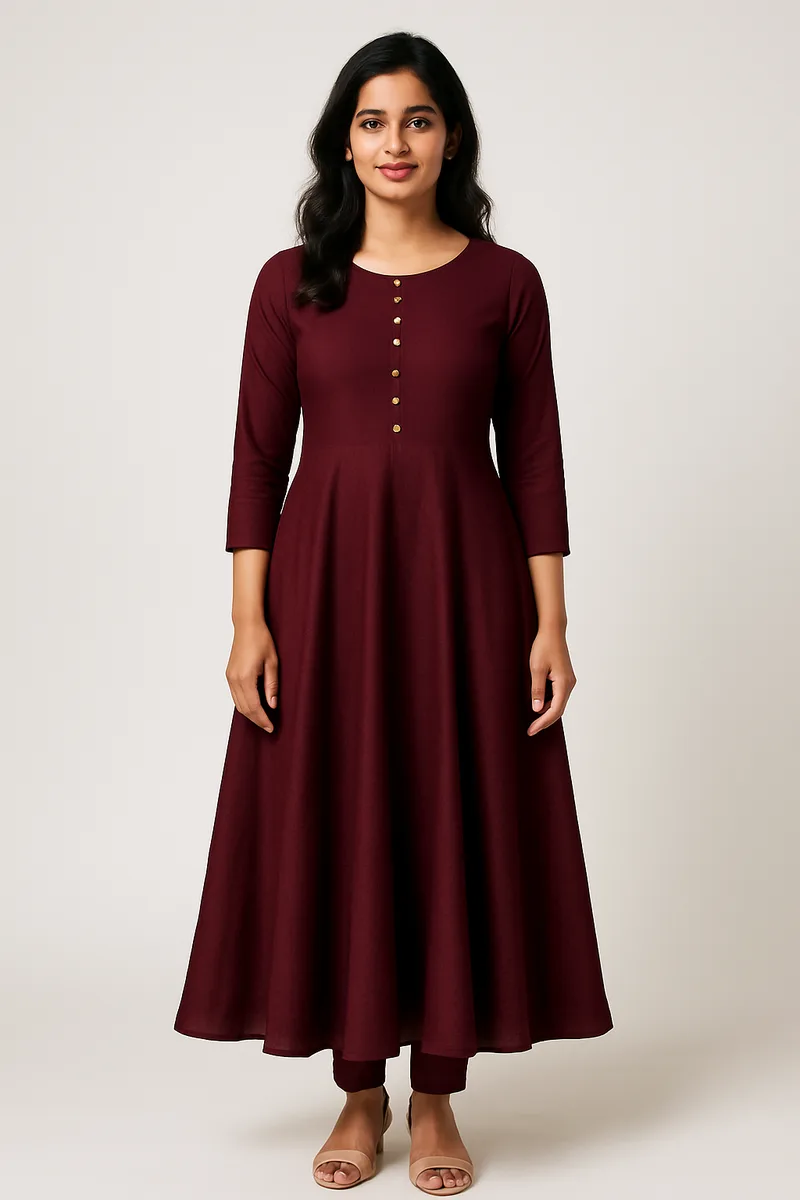
Upload one flat photo of your kurti and get an on-model shot in about 30 seconds — with the hem landing at the length you sewed it, side slits opening where they should, the dupatta draped as a separate layer, and every block print reproduced at its real scale. Built for kurti sellers shipping to US and UK buyers on Etsy, Amazon and Poshmark.


No studio, no model booking, no waiting on a photographer's calendar. One credit per generation, and you own every output with commercial rights on every plan — including the free one.
A flat-lay, a hanger shot, or the catalog photo your supplier in India sent you. Tags, clips and background clutter are removed automatically — the AI works from the garment alone.
40+ models across skin tones and body types, 50+ backgrounds — from studio white for Amazon MAIN images to lifestyle scenes for Etsy and Instagram. South Asian models included, but your kurti looks right on any of them.
Generation takes about 30 seconds. Export at Etsy's 2000px, Amazon's 1600px+, or Poshmark's 3:4 portrait covershot. No watermarks, ever.


Most AI try-on tools were trained on Western t-shirts and dresses. Feed them a kurti and the failure modes are predictable — and each one is a return waiting to happen, because the buyer receives a garment that doesn't match the photo.
You photograph a knee-length straight-cut kurti; the output shows it at mid-calf, or cropped to hip length like a tunic top. For a garment whose entire category is defined by where the hem falls, that's not a cosmetic error — it misrepresents the product.
CatalogX measures the garment first and anchors the hem to an inches-based length band before generating.The side slit is a construction feature: it sets how the kurti moves over leggings or jeans. Generic models either seal the slit shut or extend it to the waist, changing how the garment reads entirely.
Slit depth is treated as part of the garment's construction and reproduced where your photo shows it.Give a generic tool a kurti set and the dupatta merges into the bodice — its fabric, border and transparency absorbed into the kurti as if they were one piece of cloth.
CatalogX renders the dupatta as a separate draped layer with its own border and fall.Three-quarter sleeves become full sleeves; full sleeves get rolled into cuffs that don't exist. Sleeve length is a listed attribute on every marketplace — the photo has to match it.
Sleeve ends are located in the source photo and held fixed in the output.A fine block print becomes a blown-up abstract pattern; a bold Ajrakh motif shrinks into noise. The print repeat — the size and spacing of the motif — is what the buyer is actually buying.
Prints are preserved at their photographed scale; the repeat you printed is the repeat the buyer sees.Generic AI loves to "improve" a plain yoke with imaginary embroidery, or smooth real mirror-work into a blur. Either way, the listing photo lies.
Nothing is added that your photo doesn't show. A plain kurti stays plain; real embroidery stays sharp and stays put.This is the difference between a general-purpose try-on model and one purpose-built for South Asian garments. CatalogX runs a measure-then-generate pipeline: before any pixels are produced, the system analyzes the kurti's proportions — hem position relative to the body, slit depth, sleeve termination — and anchors the generation to those measurements. The output is then checked against the same measurements, so a kurti that should hit the knee can't quietly become calf-length between upload and download. The same discipline applies across our ethnic-wear range: saree pleat and pallu direction, border continuity, lehenga flare. If you also sell sarees, the saree model photos page covers how that works.
"Kurti" covers half a dozen distinct silhouettes, and each one has its own failure mode in generic AI. CatalogX treats the cut as part of the garment's identity.
The workhorse of the category: a clean vertical fall from shoulder to hem, usually knee-length, worn over jeans, leggings or cigarette pants. The whole silhouette depends on the fabric hanging straight — no flare invented at the hem, no waist pinched in. CatalogX keeps the column intact and the hem at the knee where you cut it.
Fitted through the yoke and bust, then flaring into a full, panelled skirt — often floor-grazing, often paired with a churidar whose gathered ankles show below the hem. The flare is the sell: it has to swing wide and fall in even kalis, not collapse into a straight tube. The fitted-to-flared transition point stays where your garment puts it.
Between the two: fitted at the shoulders, widening gradually to the hem in a clean A. The angle of the flare is subtle enough that generic AI routinely flattens it into a straight-cut or exaggerates it into an anarkali. CatalogX reads the flare angle from your photo and holds it — and holds the print repeat steady across the widening panels.
Two- and three-piece sets are where most tools fall apart, because they're rendering multiple garments at once. CatalogX keeps the pieces separate: the dupatta drapes over the shoulder as its own layer with its own border and sheerness; palazzo bottoms keep their wide, flowing leg under the kurti's hem; a churidar keeps its gathered, close-fitting ankle. The set in the photo is the set in the parcel — which is exactly what Etsy's and Amazon's accuracy rules ask of a listing image.
Worth naming for search-minded sellers: a kurti is the shorter women's cut (thigh to knee); a kurta is the longer tunic, calf-length or below, traditionally unisex. Buyers search both terms — your photos should show the difference, and hem anchoring is what makes it visible.
Put this kurti on a model — free →A US studio session runs $300+ before model fees — or $50–150 per finished image. For a catalog of 30 kurtis in three colorways each, that math never closes. Here's the honest three-way comparison.
| US studio photoshoot | Generic AI try-on | CatalogX | |
|---|---|---|---|
| Cost per finished image | $50–150, plus $300+ per session before model fees | Low | From free (5 credits, no card); plans $9.99–$49.99/mo |
| Turnaround | Days to weeks — booking, shooting, retouching | Minutes | ~30 seconds per image |
| Kurti hem length | Perfect — it's a real garment on a real model | Drifts between knee and calf unpredictably | Measured and anchored to a length band before generation |
| Dupatta & sets | Perfect, if your stylist knows ethnic wear | Dupatta merges into the kurti; sets collapse into one garment | Rendered as separate pieces with their own drape |
| Print & embroidery fidelity | Exact | Print scale distorts; details get invented or smoothed away | Product pixels preserved at photographed scale |
| New colorway | Full re-shoot | Re-generate, re-roll the dice | One credit, same pose and lighting |
| Best for | Hero brand imagery, campaigns | Western basics — tees, dresses | South Asian & ethnic wear catalogs at volume |
To be fair to all three: if you're building a brand campaign with a specific creative vision, a real photoshoot is still the right tool — and generic AI try-on is genuinely good at Western basics. The gap CatalogX fills is the one in the middle: a full ethnic-wear catalog that needs marketplace-accurate photos at a per-image cost that works on Etsy and Amazon margins. The full cost breakdown is in our AI photoshoot vs studio cost guide.
Yes. Kurtis are adult apparel, and Amazon US requires the MAIN image for adult clothing to show the product on a standing human model — no mannequins, no flat-lays — on a pure white background, filling roughly 85% of the frame, at 1600px or larger (2000px recommended). CatalogX generates exactly that: a standing model wearing your kurti on studio white at high resolution, so your MAIN image complies without a photoshoot.
No. CatalogX reproduces the garment as photographed: block prints keep their repeat, embroidery on the yoke stays where you placed it, and a plain kurti stays plain. Nothing is invented that your photo doesn't show.
CatalogX measures the garment's proportions before generating and anchors the hem to a real length band — thigh, knee, mid-calf or ankle — so a knee-length straight-cut kurti lands at the knee on the model, not drifting to the calf. Every output is checked against that measured band before it reaches you.
Yes. A kurti set is rendered as its separate pieces: the dupatta stays a distinct draped layer instead of merging into the kurti's fabric, and palazzo or churidar bottoms keep their own silhouette under the hem. Three-piece sets are one of the specific cases CatalogX is built and tested against.
A kurti is the shorter women's cut, typically thigh to knee length and often worn over jeans, leggings or palazzos; a kurta is the longer, traditionally unisex tunic reaching the calf or below. CatalogX handles both — the hem-length anchoring is what keeps the distinction visible in the output, which matters because buyers search both terms with different expectations.
A US studio session runs $300+ before model fees, or $50–150 per finished image. CatalogX starts free with 5 credits and no card required; paid plans run $9.99–$49.99 per month (one-time packs at the same prices exist too), each generation takes about 30 seconds, and you own every image with full commercial rights on every plan.
A flat-lay, a hanger shot or your supplier's catalog photo all work. The clearer the print and construction details — neckline, sleeve ends, side slits, hem — the better, because those are exactly the features the AI is instructed to preserve. Our kurti photography guide covers how to take a good source photo with a phone.
Both platforms require photos to accurately represent the item you ship — and CatalogX renders your real kurti faithfully on the model, so the photo shows what the buyer receives. Export at Etsy's recommended 2000px shortest side or Poshmark's 3:4 portrait covershot directly. See our Etsy guide and Poshmark guide for each platform's full image rules.
Upload the hardest piece in your catalog — the anarkali set with the sheer dupatta — and see the fall, the slit and the print come through intact. 5 free credits, no card.