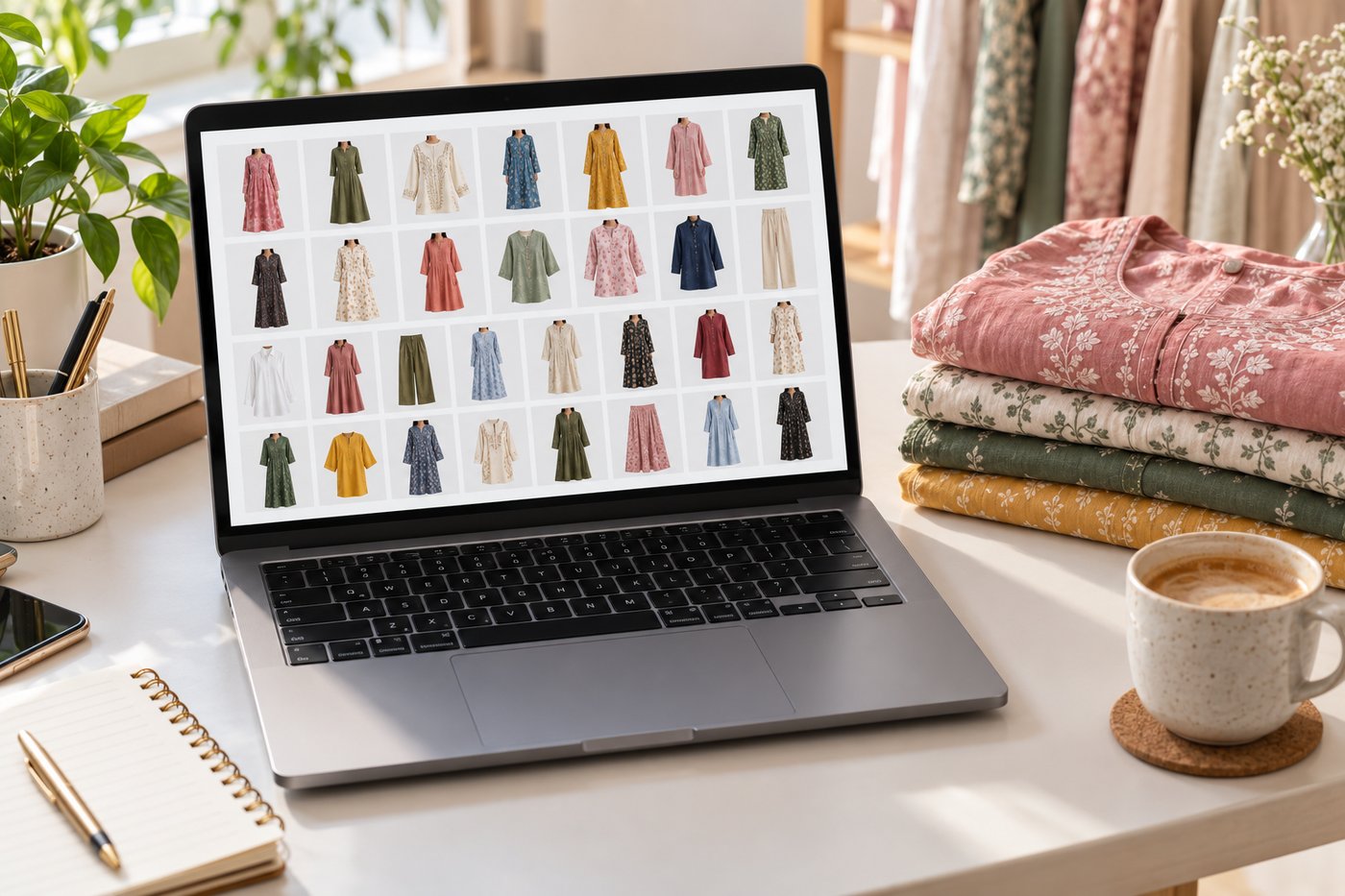
The best AI virtual try-on tools for Indian fashion sellers in 2026 are CatalogX, FASHN.ai, WearView, StitchMagic, Botika, TryVastra, and Looksy AI. Each handles garment-to-model generation differently — here's how they compare on features, pricing, Indian ethnic wear support, and marketplace compliance.
If you sell fashion online in India, you already know the challenge: buyers expect model-on shots for every listing, but traditional photography is expensive, slow, and hard to scale. AI virtual try-on tools solve this by letting you upload a flat garment image and generate a photorealistic image of a model wearing that garment — no studio, no photographer, no two-week turnaround. The technology has matured rapidly, and in 2026, several tools are competing for the attention of Indian fashion sellers. But not all of them are built for the Indian market, and the differences matter more than you might expect.
This guide compares seven AI virtual try-on tools that are relevant to Indian fashion sellers. We cover what each tool does well, where it falls short, how much it costs, and — critically — how well it handles the unique demands of Indian ethnic wear like sarees, kurtas, lehengas, and sherwanis. If you want to understand how AI virtual try-on technology works at a technical level, we have a separate deep-dive on that topic.
What is AI virtual try-on and why does it matter for Indian sellers?
AI virtual try-on is a technology that takes a photograph of a garment — typically a flat-lay or mannequin shot — and generates a new image showing that garment on a human model. The AI handles draping, shadows, lighting, fabric texture, and body proportions automatically. The output is a photorealistic image that looks like it was taken in a professional studio, but was generated in under a minute without any physical photoshoot.
For Indian fashion sellers, this technology is particularly valuable for several reasons:
- Cost reduction: A single product photoshoot with a model costs INR 5,000 to INR 50,000+ per SKU depending on the garment type and your location. AI virtual try-on reduces this to a few rupees per image.
- Speed to market: Sellers who list products faster capture early traffic and sales. AI try-on lets you go from garment sample to marketplace-ready images in under an hour, rather than waiting two weeks for a photoshoot and editing cycle.
- Catalog consistency: When you shoot products across multiple sessions with different photographers and models, your catalog looks fragmented. AI tools generate every image with the same model, pose style, and lighting — creating a cohesive brand appearance across hundreds of listings.
- Ethnic wear complexity: Indian garments like sarees, lehengas, and anarkalis involve complex draping that is difficult and expensive to photograph well. AI tools trained on these garment types can render draping consistently and accurately.
- Marketplace compliance: Amazon India, Flipkart, Myntra, and Meesho each have specific image requirements — aspect ratios, background colors, minimum resolutions. The right AI tool can auto-format images for each platform.
The question is no longer whether to use AI virtual try-on — it is which tool to use. Not all tools are created equal, and the differences become especially apparent when you work with Indian ethnic wear or need to comply with Indian marketplace image standards.
How we evaluated these tools
This comparison is based on hands-on testing and real-world usage, not marketing materials. We evaluated each tool across eight criteria that matter most to Indian fashion sellers:
- Image quality: How photorealistic are the generated images? Can they pass as real studio photography on a marketplace listing page?
- Indian ethnic wear support: Can the tool handle sarees, kurtas, lehengas, sherwanis, salwar suits, and other Indian garment types? Does it understand pallu draping, dupatta placement, and embroidery rendering?
- Marketplace export: Does the tool export images in the correct dimensions and formats for Amazon India, Flipkart, Myntra, and Meesho without manual resizing?
- Pricing for the Indian market: Is it affordable for small and mid-size Indian sellers? Is pricing available in INR? Does the per-image cost make economic sense at Indian price points?
- Ease of use: How quickly can a non-technical seller go from garment photo to finished listing image? Is the interface intuitive?
- Model diversity: Does the tool offer models with Indian body types, skin tones, and styling that are appropriate for Indian fashion listings?
- Background options: Does it support white backgrounds (required by most marketplaces), lifestyle backgrounds, and festival-themed backgrounds relevant to the Indian market?
- Additional tools: Does the platform include background removal, HD upscaling, color variant generation, or other tools that reduce dependency on external software?
Each tool was tested with at least three garment types: a saree, a men's kurta, and a western wear item (t-shirt or dress). This gave us a baseline for comparing how each tool handles both ethnic and western garments.
Which tools made our list?
Here is the at-a-glance comparison of all seven tools. Scroll right on mobile to see all columns.
| Tool | Price | Indian Ethnic Wear | Marketplace Export | Free Tier |
|---|---|---|---|---|
| CatalogX | From INR 299 (starter) | Full support (14+ types) | Amazon IN, Flipkart, Myntra, Meesho | 5 free credits |
| FASHN.ai | From $19/mo | Partial (basic kurtas) | No | Limited free generations |
| WearView | From $29/mo | Minimal | No | 3-day trial |
| StitchMagic | From INR 700/mo | Good (sarees, kurtas, lehengas) | Amazon IN, Flipkart | 10 free images |
| Botika | From $25/mo | Minimal | No | No free tier |
| TryVastra (VERA) | From INR 599/mo | Strong (ethnic wear focused) | Amazon IN, Myntra | 5 free images |
| Looksy AI | From $15/mo | Partial | No | 5 free images |
Detailed reviews: how each tool performs
Below, we break down each of the seven tools in detail — covering what it does, how much it costs, its strengths, and its limitations. The tools are ranked in order of overall suitability for Indian fashion sellers.
1. CatalogX — Best overall for Indian fashion sellers
CatalogX is an AI virtual try-on platform built specifically for Indian fashion e-commerce. Unlike tools that were designed for western markets and retrofitted for India, CatalogX was purpose-built to handle the full range of Indian garment types — from the complex pallu draping of sarees to the embroidery detailing on sherwanis and the dupatta styling on salwar suits. The platform uses a specialized image generation pipeline that combines OpenAI's latest models with garment-specific prompt engineering and post-processing to produce results that are consistently marketplace-ready.
The workflow is straightforward: upload a flat-lay or mannequin photo of your garment, select a model from the library (which includes Indian body types, skin tones, and poses appropriate for ethnic wear), choose a background, and generate. Results arrive in under 60 seconds. The platform also includes built-in background removal and HD upscaling tools so you do not need separate subscriptions for those capabilities.
What sets CatalogX apart is its deep understanding of Indian fashion. Sarees are not just "draped fabric" to the AI — the system understands pallu placement, pleating, and how different saree styles (Banarasi, Kanjivaram, chiffon) should hang on a model. Similarly, kurtas are generated with correct collar and sleeve detailing, and lehengas render with accurate flare and dupatta positioning. This garment-specific intelligence is the result of prompt templates and training data curated specifically for Indian fashion categories, and it shows in the output quality.
Pricing: CatalogX uses a credit-based system priced in INR. You get 5 free credits on signup with no credit card required. The Starter pack is INR 299 for 15 credits, and each generation costs 1 credit. This makes it one of the most affordable options for Indian sellers, especially when you factor in the included marketplace export, background removal, and HD upscale features that would cost extra with other tools. See catalogx.app/pricing for current plans.
Pros:
- Best-in-class Indian ethnic wear support with 14+ garment types including sarees, kurtas, lehengas, sherwanis, and salwar suits
- One-click marketplace export for Amazon India (1:1, white background), Flipkart (1:1), Myntra (3:4), and Meesho
- INR-based pricing designed for Indian seller economics — no USD subscription overhead
- Built-in background removal and HD upscale included at no extra cost
- Indian model library with appropriate body types, skin tones, and poses for ethnic wear
- 50+ background options including festival themes (Diwali, Eid, Holi) relevant to Indian seasonal selling
- Face overlay technology preserves model identity across multiple garments
Cons:
- Newer platform compared to some global competitors — the model library is still growing
- Bulk batch generation caps at 20 garments per run — larger catalogs take multiple runs
- API access requires the Business plan (₹3,000/month); there is no lower-priced API tier
2. FASHN.ai — Best for western wear with some Indian potential
FASHN.ai is a well-funded AI virtual try-on platform that has gained traction primarily among western fashion brands and DTC labels. The tool produces high-quality model-on images for garment categories like t-shirts, dresses, jackets, and jeans. The AI understands fabric physics well for these categories, generating realistic wrinkles, shadows, and draping. FASHN.ai also offers a robust API, making it a popular choice for fashion-tech companies building try-on into their own platforms.
For Indian sellers, FASHN.ai has mixed relevance. It handles basic Indian garments like plain kurtas and straight-cut kurtis reasonably well, but struggles with complex draping — sarees, heavily embroidered lehengas, and garments with dupattas often come out looking flat or incorrectly draped. The model library skews western, and there is no Indian marketplace export feature. Pricing is in USD, which adds overhead for Indian sellers operating on thin margins.
Pricing: FASHN.ai offers a limited free tier (approximately 10 generations). Paid plans are $19/month (Basic), $49/month (Pro) and $99/month (Agency), with a higher Agency tier around $198/month. Unused monthly credits roll over from September 2026. Enterprise pricing is available for higher volumes. All pricing is in USD.
Pros:
- Strong image quality for western wear categories
- API available for integration with existing e-commerce platforms
- Good fabric rendering for cotton, denim, silk in western silhouettes
- Active development team with frequent model updates
Cons:
- Limited support for Indian ethnic wear — sarees and lehengas render poorly
- No Indian marketplace export (Amazon India, Flipkart, Myntra, Meesho)
- USD pricing adds 15-20% overhead for Indian sellers after currency conversion
- Model library lacks Indian body types and styling
3. WearView — Best for international DTC brands
WearView positions itself as an enterprise-grade virtual try-on solution for fashion brands selling direct-to-consumer. The platform offers high-resolution output, customizable model poses, and a clean interface that appeals to brand teams. WearView's strength is consistency — once you configure a model and lighting setup, it produces uniform results across large catalogs, which is valuable for brands that need a cohesive look across hundreds of SKUs.
WearView is built for the international market, particularly the US, UK, and EU. It has no India-specific features — no ethnic wear support, no Indian marketplace export, and no INR pricing. The model library is entirely western. For Indian sellers working with western wear categories (t-shirts, dresses, casual wear) who are selling internationally, WearView is a viable option. For anyone selling Indian ethnic wear on Indian marketplaces, it is not the right fit.
Pricing: WearView starts at $29/month for 50 images. The Professional plan is $79/month for 200 images. Enterprise plans with custom model training are available. A 3-day free trial is offered but requires a credit card.
Pros:
- High-resolution, consistent output suitable for premium brand catalogs
- Customizable lighting and pose configurations for brand consistency
- Good integration with Shopify and international e-commerce platforms
- Batch processing for catalog-scale generation
Cons:
- No Indian ethnic wear support whatsoever
- No Indian marketplace export or compliance features
- Higher price point makes it uneconomical for small Indian sellers
- Free trial requires credit card and lasts only 3 days
4. StitchMagic — Best India-focused alternative to CatalogX
StitchMagic is an Indian-built AI fashion tool that focuses on generating model shots for e-commerce listings. Like CatalogX, it targets Indian fashion sellers specifically and supports several Indian garment types including sarees, kurtas, and lehengas. StitchMagic has built a following among small to mid-size sellers on Flipkart and Amazon India, and offers INR pricing that makes it accessible to the Indian market.
The tool's ethnic wear support is good but not as comprehensive as CatalogX. Saree draping is handled well for simple styles, but heavily embroidered or printed sarees sometimes lose detail in generation. Lehenga rendering is adequate for most listing purposes. The model library includes Indian models, though the variety is more limited. StitchMagic offers marketplace export for Amazon India and Flipkart, but does not yet support Myntra or Meesho formatting.
Pricing: StitchMagic starts at INR 700/month, with a low-cost paid trial. The Pro plan is INR 999/month for 80 images. A free tier offers 10 images on signup. All pricing is in INR.
Pros:
- India-focused platform with INR pricing
- Good saree and kurta support for basic styles
- Marketplace export for Amazon India and Flipkart
- Active Indian seller community with responsive support
Cons:
- Embroidery and print detail can be lost on complex garments
- No Myntra or Meesho marketplace export
- Smaller model library compared to CatalogX
- No built-in background removal or HD upscale — requires external tools
5. Botika — Best for high-volume western fashion brands
Botika is a well-established AI fashion photography platform that caters primarily to mid-size and large western fashion brands. The tool is known for producing high-quality model-on images with excellent fabric rendering, natural lighting, and professional studio-grade output. Botika supports batch processing, custom model creation, and has integrations with Shopify and other major e-commerce platforms.
For Indian fashion sellers, Botika presents a significant mismatch. The tool has no support for Indian ethnic wear categories — sarees, kurtas, and lehengas are not recognized garment types in the system. The model library consists entirely of western models with no Indian body types or skin tones available. There is no Indian marketplace export functionality. The USD pricing starts at $25/month, which is on the higher end for Indian sellers. Botika is a strong tool for what it does, but it was not built for the Indian market.
Pricing: Botika starts at roughly $22–25/month. The Scale plan is $75/month for 200 images. Enterprise pricing is custom. A small free credit allowance is offered on signup rather than an ongoing free tier.
Pros:
- Excellent image quality for western fashion categories
- Batch processing for high-volume catalog generation
- Custom model creation for brand-specific looks
- Established platform with proven track record
Cons:
- Zero support for Indian ethnic wear — sarees, kurtas, lehengas not handled
- No Indian models in the library
- No Indian marketplace export
- No free tier — higher entry cost for experimentation
- USD pricing is expensive for small Indian sellers
6. TryVastra (VERA) — Best ethnic wear specialist (limited scope)
TryVastra, powered by the VERA AI engine, is an Indian-built virtual try-on tool that focuses specifically on ethnic wear. The tool was designed with Indian garments as the primary use case, and it shows — saree draping is handled well, with the AI understanding pallu styles, pleating patterns, and border detailing. Lehenga and salwar suit rendering is also strong. TryVastra offers Indian models with appropriate styling, and supports marketplace export for Amazon India and Myntra.
The limitation of TryVastra is its narrow scope. The tool excels at ethnic wear but struggles with western garment types. If you sell a mixed catalog of Indian and western fashion, you would need TryVastra for ethnic wear and a second tool for western items, which adds cost and complexity. The platform is also smaller than competitors like CatalogX, which means a more limited model library, fewer background options, and slower feature development. The interface, while functional, is less polished than some alternatives.
Pricing: TryVastra starts at INR 599/month for 25 images. The Professional plan is INR 1,499/month for 75 images. A free tier offers 5 images on signup. All pricing is in INR.
Pros:
- Strong ethnic wear focus with good saree, lehenga, and salwar suit support
- Indian models with culturally appropriate styling
- Marketplace export for Amazon India and Myntra
- INR pricing accessible to Indian sellers
Cons:
- Poor western wear support — limits utility for mixed catalogs
- Smaller model and background library
- Higher per-image cost compared to CatalogX
- No Flipkart or Meesho marketplace export
- Interface and user experience lag behind competitors
7. Looksy AI — Best budget option for beginners
Looksy AI is a newer entrant in the AI virtual try-on space that positions itself as a simple, affordable option for small sellers and individual entrepreneurs. The tool offers a clean, minimal interface that makes it easy to get started — upload a garment image, pick a model, and generate. Looksy AI supports a range of garment types including basic Indian categories like kurtas and kurtis, though its ethnic wear capabilities are limited compared to specialized tools.
Looksy AI's main appeal is affordability and simplicity. At $15/month for its starter plan, it is one of the more affordable options in the market, and the free tier of 5 images lets you test the tool before committing. However, the lower price point comes with trade-offs in image quality and feature depth. Output resolution is lower than premium tools, there is no Indian marketplace export, and advanced features like face overlay, print matching, and HD upscaling are not available. For sellers who are just starting out and need basic model shots on a tight budget, Looksy AI is a reasonable entry point. For sellers with higher quality standards or complex garment types, it will likely feel limiting.
Pricing: Looksy AI starts at $15/month for 40 images. The Pro plan is $39/month for 120 images. A free tier offers 5 images on signup. Pricing is in USD.
Pros:
- Simple, beginner-friendly interface with minimal learning curve
- Affordable pricing suitable for individual sellers
- Free tier for testing before committing
- Fast generation times (under 30 seconds per image)
Cons:
- Lower output quality and resolution compared to premium tools
- Limited Indian ethnic wear support — no saree or lehenga specialization
- No Indian marketplace export
- No background removal, HD upscale, or advanced editing features
- USD pricing adds currency conversion overhead for Indian sellers
Which tool is best for sarees and ethnic wear?
This is the question that matters most for Indian fashion sellers, and it is where the field narrows dramatically. Of the seven tools in this comparison, only three have meaningful support for Indian ethnic wear: CatalogX, TryVastra, and StitchMagic.
CatalogX offers the most comprehensive ethnic wear support, with 14+ garment types and garment-specific AI that understands draping, embroidery, and fabric behavior for each category. TryVastra is a close second for pure ethnic wear — its saree draping is strong, though it lacks the western wear coverage that makes CatalogX more versatile. StitchMagic handles basic ethnic wear well but loses detail on complex garments.
The remaining four tools — FASHN.ai, WearView, Botika, and Looksy AI — were not built for Indian ethnic wear and produce inconsistent or poor results with sarees, lehengas, and similarly complex garments. If ethnic wear is a significant part of your catalog, these tools are not suitable for those categories.
If you are learning to photograph sarees and kurtas without a model, AI virtual try-on is the most practical solution. You get studio-quality model shots from flat-lay garment photos without the expense and complexity of hiring models and booking studios.
How much do AI virtual try-on tools cost in India?
Pricing is a critical factor for Indian fashion sellers, many of whom operate on tighter margins than their western counterparts. Here is a detailed pricing comparison across all seven tools:
| Tool | Free Tier | Entry Plan | Pro Plan | Currency |
|---|---|---|---|---|
| CatalogX | 5 credits | INR 299 (15 credits) | INR 849/mo (55 credits) | INR |
| FASHN.ai | ~10 images | $19/mo (100 images) | $79/mo (500 images) | USD |
| WearView | 3-day trial | $29/mo (50 images) | $79/mo (200 images) | USD |
| StitchMagic | 10 images | From INR 700/mo | INR 999/mo (80 images) | INR |
| Botika | No free tier | $25/mo (50 images) | $75/mo (200 images) | USD |
| TryVastra | 5 images | INR 599/mo (25 images) | INR 1,499/mo (75 images) | INR |
| Looksy AI | 5 images | $15/mo (40 images) | $39/mo (120 images) | USD |
When comparing prices, it is important to look beyond the monthly cost and consider the effective cost per usable image. A tool that costs less per month but requires manual resizing, background removal through a separate tool, and quality retouching ends up costing more in time and money than a higher-priced tool that delivers marketplace-ready images directly.
CatalogX's credit-based system is designed for this reality. Each generation includes marketplace formatting, and background removal and HD upscale are included free on all plans. With USD-priced tools, you often need to add Photoroom ($9.99/month) for background removal and another tool for resizing — making the true cost significantly higher than the advertised price.
For sellers operating at Indian e-commerce margins — where a kurta sells for INR 500-800 and a saree for INR 1,000-3,000 — the per-image cost needs to be in the single-digit rupees range for AI photography to make economic sense. CatalogX achieves this at scale. Most USD-priced tools do not.
What about marketplace compliance?
Indian fashion marketplaces have specific image requirements that sellers must follow. Non-compliant images get rejected or suppressed in search results, directly impacting sales. Here is what each major marketplace requires and which tools handle it automatically:
Amazon India: 1:1 aspect ratio, minimum 1000x1000 pixels, white background (RGB 255,255,255), no watermarks, product must fill 85% of the frame. CatalogX, StitchMagic, and TryVastra support Amazon India export. The other tools require manual formatting.
Flipkart: 1:1 aspect ratio, minimum 600x600 pixels, white or light background, high-resolution images preferred. CatalogX and StitchMagic support Flipkart export.
Myntra: 3:4 aspect ratio, minimum 1080x1440 pixels, clean background, model-on shots strongly preferred for fashion categories. CatalogX and TryVastra support Myntra export.
Meesho: 1:1 aspect ratio, white background, model-on images required for most fashion categories. CatalogX is the only tool in this comparison that supports Meesho export formatting.
CatalogX is the only tool that supports all four major Indian marketplaces with one-click export. If you sell across multiple platforms — which most Indian fashion sellers do — this eliminates hours of manual image resizing and formatting for each SKU. For a detailed guide on marketplace image requirements, see our article on best AI product photo tools comparison.
Can AI virtual try-on replace real photography entirely?
In 2026, AI virtual try-on can replace traditional studio photography for the majority of e-commerce listing images. The quality gap between AI-generated and professionally photographed model shots has narrowed to the point where most buyers cannot tell the difference on a marketplace listing page.
That said, there are scenarios where real photography still has an edge:
- Hero images for premium brands: If you are a premium brand selling lehengas at INR 50,000+, your hero lifestyle images should still be shot professionally. AI can supplement with additional angles and marketplace-format images.
- Highly reflective or transparent fabrics: Sequinned fabrics, organza, and net materials can sometimes produce AI artifacts. The technology is improving rapidly, but these edge cases still benefit from real photography.
- Video content: AI virtual try-on currently generates still images. If you need video content for social media or marketplace video slots, you still need real shoots or AI video tools (a separate category).
- Lookbook and editorial content: Creative editorial shoots with specific art direction, multiple models, and complex styling are better handled by real photographers. AI excels at standardized catalog images, not creative campaigns.
For most Indian fashion sellers — especially those selling on marketplaces — AI virtual try-on can handle 80-100% of their product image needs. The remaining edge cases can be supplemented with selective real photography for hero products.
Which tool should you choose?
Here is the simplified decision framework based on your specific situation:
- If you sell Indian ethnic wear on Indian marketplaces: CatalogX is the clear first choice. It is the only tool that combines comprehensive ethnic wear support with export for all four major Indian marketplaces, and its INR pricing makes economic sense for Indian seller margins.
- If you sell primarily ethnic wear and want a second opinion: TryVastra is worth testing alongside CatalogX. Its saree draping is good, though the limited western wear support and higher per-image cost are drawbacks.
- If you are an Indian seller on a very tight budget: StitchMagic offers INR pricing and basic ethnic wear support at a lower price point. The trade-off is in image quality and feature depth.
- If you sell western fashion to international markets: FASHN.ai or Botika both produce strong results for western garment types. FASHN.ai is more affordable and offers a free tier; Botika has better batch processing.
- If you are a DTC brand selling internationally: WearView offers enterprise-grade consistency and Shopify integration, but at a premium price.
- If you are just starting out and want to experiment: CatalogX's 5 free credits with no credit card required is the lowest-risk way to test AI virtual try-on. Looksy AI is another affordable starting point, though with lower output quality.
What trends are shaping AI virtual try-on in India?
The AI virtual try-on market in India is evolving rapidly. Several trends are worth watching as you make your tool selection:
Video try-on is coming. Several platforms, including CatalogX, are developing AI video generation capabilities that will let sellers create short product videos from flat garment photos. This will be particularly impactful for platforms like Instagram Shopping and Myntra, where video content drives significantly higher engagement than static images.
Marketplace integration is deepening. Rather than just formatting images for marketplaces, the next generation of tools will integrate directly with marketplace seller dashboards — letting you generate and upload images without leaving Flipkart Seller Hub or Amazon Seller Central.
Multi-garment try-on is improving. Generating a model wearing a complete outfit — lehenga with matching blouse and dupatta, or kurta with churidar and stole — is becoming possible with newer AI models. This was a major limitation in 2024-2025 and is now rapidly improving.
Regional language support is expanding. Tools are beginning to offer interfaces in Hindi, Tamil, Telugu, and other Indian languages, reducing barriers for sellers who are not comfortable operating in English-only interfaces.
Price per image continues to fall. As AI model costs decrease and competition intensifies, the per-image cost of virtual try-on is dropping. What cost INR 50-100 per image in 2024 now costs INR 10-15, and the trajectory points toward single-digit rupees within the next year.
Bottom line
AI virtual try-on has moved from experimental novelty to essential business tool for Indian fashion sellers. The seven tools in this comparison represent the current state of the market, but they are not interchangeable — the right choice depends heavily on what you sell, where you sell it, and how much you can invest.
For Indian fashion sellers — especially those working with ethnic wear and selling on Indian marketplaces — CatalogX offers the most complete solution. It is the only tool that combines deep Indian ethnic wear understanding, all four major marketplace exports, INR pricing, and built-in editing tools in a single platform. The free tier makes it easy to test with zero risk.
For sellers focused on western fashion or selling internationally, FASHN.ai, Botika, and WearView are all capable tools worth evaluating for those specific use cases.
Whatever you choose, the key is to start. The sellers who are already using AI virtual try-on are listing faster, spending less on photography, and presenting more consistent catalogs to buyers. Every week you wait is a week your competitors are building that advantage.
Frequently asked questions
CatalogX is the best AI virtual try-on tool for Indian fashion sellers. It supports 14+ Indian garment types including sarees, kurtas, and lehengas, offers one-click marketplace export for Amazon India, Flipkart, Myntra, and Meesho, and uses INR-based credit pricing designed for the Indian market. It also includes built-in background removal and HD upscaling at no extra cost.
Most global AI virtual try-on tools struggle with complex Indian garments like sarees and lehengas because their AI models are trained primarily on western clothing. CatalogX and TryVastra are the two tools in this list with dedicated support for Indian ethnic wear draping, pallu placement, and embroidery rendering. StitchMagic offers basic ethnic wear support but can lose detail on heavily embroidered garments.
Pricing varies widely. CatalogX starts at INR 299 for a starter pack of 15 credits. StitchMagic starts at INR 700/month. TryVastra starts at INR 599/month. Global tools like FASHN.ai start at $19/month and Botika at $25/month (approximately INR 1,600 and INR 2,100 respectively). CatalogX offers 5 free credits with no credit card required.
Yes. Amazon India and Flipkart do not prohibit AI-generated product images as long as they meet the platform's image quality guidelines — correct aspect ratios, minimum resolution, white or clean backgrounds, and accurate product representation. CatalogX auto-formats images to meet these requirements with one-click marketplace export.
No. Most modern AI virtual try-on tools including CatalogX are designed for non-technical users. You upload a garment photo, choose a model and background, and the AI generates the image in under a minute. No prompt engineering, Photoshop skills, or coding knowledge is required. The entire workflow is point-and-click.
In 2026, the best AI virtual try-on tools produce images that are nearly indistinguishable from professional studio photography for most e-commerce listing purposes. Fabric texture, draping, lighting, and shadows are rendered realistically. The main limitation is with highly reflective or transparent fabrics like sequins and organza, where AI can sometimes produce minor artifacts.