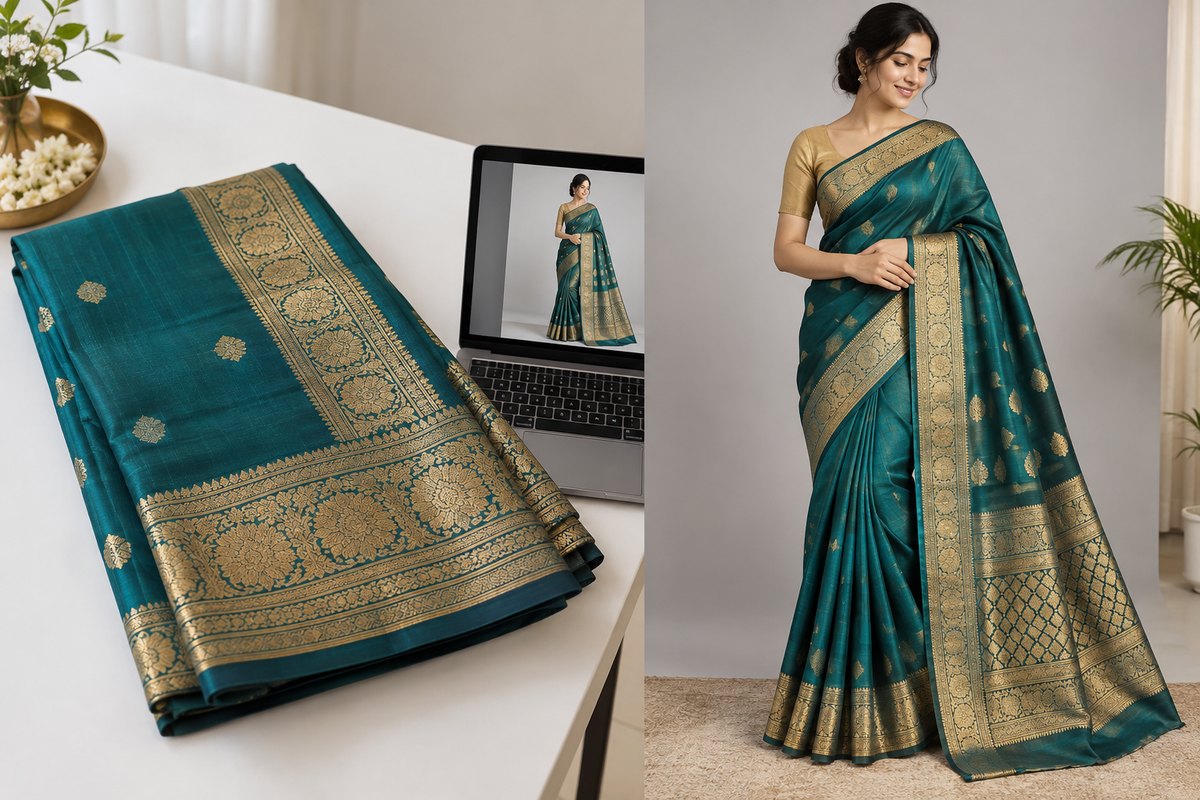
The best AI tool for saree and kurti model photos is the one that reproduces your actual garment — pallu, border, blouse, print and colour — not the one with the prettiest demo. CatalogX is built around that, with checks before and after every photo: your upload is checked for seven common photo problems, the saree's pallu, border and blouse come in as separate photos, the garment is measured before anything is generated, and an AI reviewer compares every result with your original — Quality mode re-shoots the ones that drift, free. The same photo then carries through to an e-commerce pack, a product video and a Listing Pack for 17 marketplaces. From ₹12 a photo, with 5 free photos to test on your hardest saree.
The five quality checks that decide a saree photo
A saree is the hardest garment in Indian e-commerce for AI to get right. The photo you upload is usually folded or stacked, so the parts buyers look at most — the pallu and the border — are partly hidden. Judge any tool on these five things, at full size, against the real saree:
| Check | What goes wrong | How CatalogX handles it |
|---|---|---|
| Your photo | A folded, cut-off, dark or screenshot photo hides the design, so any tool guesses | Every upload is checked for seven problems — folded, cut off, other garments in frame, screenshot, too small, too dark, detail too small to read — and you are told how to fix the photo first |
| Pallu | The tool cannot see your pallu, so it invents an ornate one or repeats the body pattern | A separate pallu close-up slot; the pallu design is taken from that photo only |
| Border | Zari border simplified, doubled, or broken partway down the drape | A separate border close-up slot alongside the main saree photo |
| Blouse | A generic blouse, or the saree's pattern copied onto it | A separate blouse slot; an unstitched piece is tailored the way a tailor cuts it — plain fabric as the bodice, border on the sleeve hems |
| Print and colour | Motifs smoothed out, scaled wrong, or the colour shifted | Colour can be corrected on your photo first; the garment is measured before generation; an AI reviewer compares the output with your original, and Quality mode re-shoots below-bar images free |
| Drape and fall | Stiff or unnatural pleats; a silk falls like cotton | Pleated or free-flowing pallu, and six fabric settings (silk, soft silk, georgette, cotton, organza, net) |
Kurtis are less demanding, but the same principle holds: print scale, neckline, sleeve length and hem length are what buyers return a kurti over. CatalogX lets you set the kurti length (short, knee or long) so a tunic is not rendered as a long kurta, and takes the pants and dupatta as separate uploads.
Why the cheapest photo is rarely the cheapest
Credits are not photos, and generated photos are not usable photos. A seller who regenerates an image three times because the border changed has paid four times for one listing photo — and a photo that ships with the wrong pallu costs a return, a bad review and sometimes a marketplace quality strike.
That is why CatalogX spends on the review step rather than racing to the lowest headline price. On Pro and above, Quality mode reviews every result against your original photo and re-shoots below-bar images free — 3 times a day on Pro, 5 on Business. What matters is the price per usable photo: CatalogX starts from ₹12, with Starter at ₹299 for 15 photos, Pro at ₹849 for 50 and Business at ₹3,000 for 200.
From one saree photo to a live listing
A model photo is the start of a listing, not the end. In CatalogX the same garment carries through every step — and each step re-runs from your original photo, not from the previous output, so the colour and print do not drift as you go.
- Upload a flat, folded, hanger or mannequin photo, with pallu, border and blouse close-ups.
- Model photo in about 30 seconds — 129 AI models and 121 backgrounds, or your own saved model and backdrop on Pro and above, so a 40-piece drop reads as one shoot.
- E-commerce pack — angle and detail shots built from the photo you approved (a back view when you upload a back photo).
- Colour variants of the same design without re-shooting.
- Product video from Pro: 4, 6 or 8-second clips.
- Listing Pack, free: every image resized for 17 marketplaces — Meesho, Flipkart, Myntra, Amazon India, AJIO, Nykaa Fashion, JioMart, Snapdeal and more — with each marketplace's bulk-upload sheet and a written title, bullets and description.
- WhatsApp catalogue card, free, for wholesale and resellers.
How to test any tool in ten minutes
- Pick your hardest product — a saree with a visible zari border and a decorated pallu, or a kurti with a small dense print. Easy garments look good everywhere.
- Upload everything you have: the full saree, a pallu close-up, a border close-up and the blouse piece.
- Compare at full size against the real garment: border continuity, pallu design, blouse, print scale, colour.
- Count usable images, not generated ones, and divide what you paid by that number.
Frequently asked questions
Accuracy depends on what the tool can see. A tool that only takes one folded saree photo has to guess the pallu and border. CatalogX takes the saree, pallu close-up, border close-up and blouse piece separately, measures the garment before generating, and on Pro and above reviews every result against your original photo.
Yes. Upload a photo of the saree — flat, folded, on a hanger or a mannequin — and the tool generates an Indian model wearing it. For an accurate result, also upload close-ups of the pallu and border and a photo of the blouse piece.
From ₹12 a photo. Starter is ₹299 for 15 photos, Pro ₹849 for 50 and Business ₹3,000 for 200, and the first 5 photos are free with no card.
Yes. In CatalogX an unstitched blouse piece is tailored the way a tailor would cut it: the plain fabric becomes the bodice and sleeves, and any border goes on the sleeve hems.
Subscription credits roll over for as long as the plan is active, up to three months' worth. One-time packs are spendable for one month; after that the balance is held, not deleted, and becomes spendable again when you buy another pack or start a plan.
Yes, as long as the image accurately represents the product and meets each marketplace's image specifications. An AI image that changes the colour, border or print is a misrepresentation whether or not AI made it.