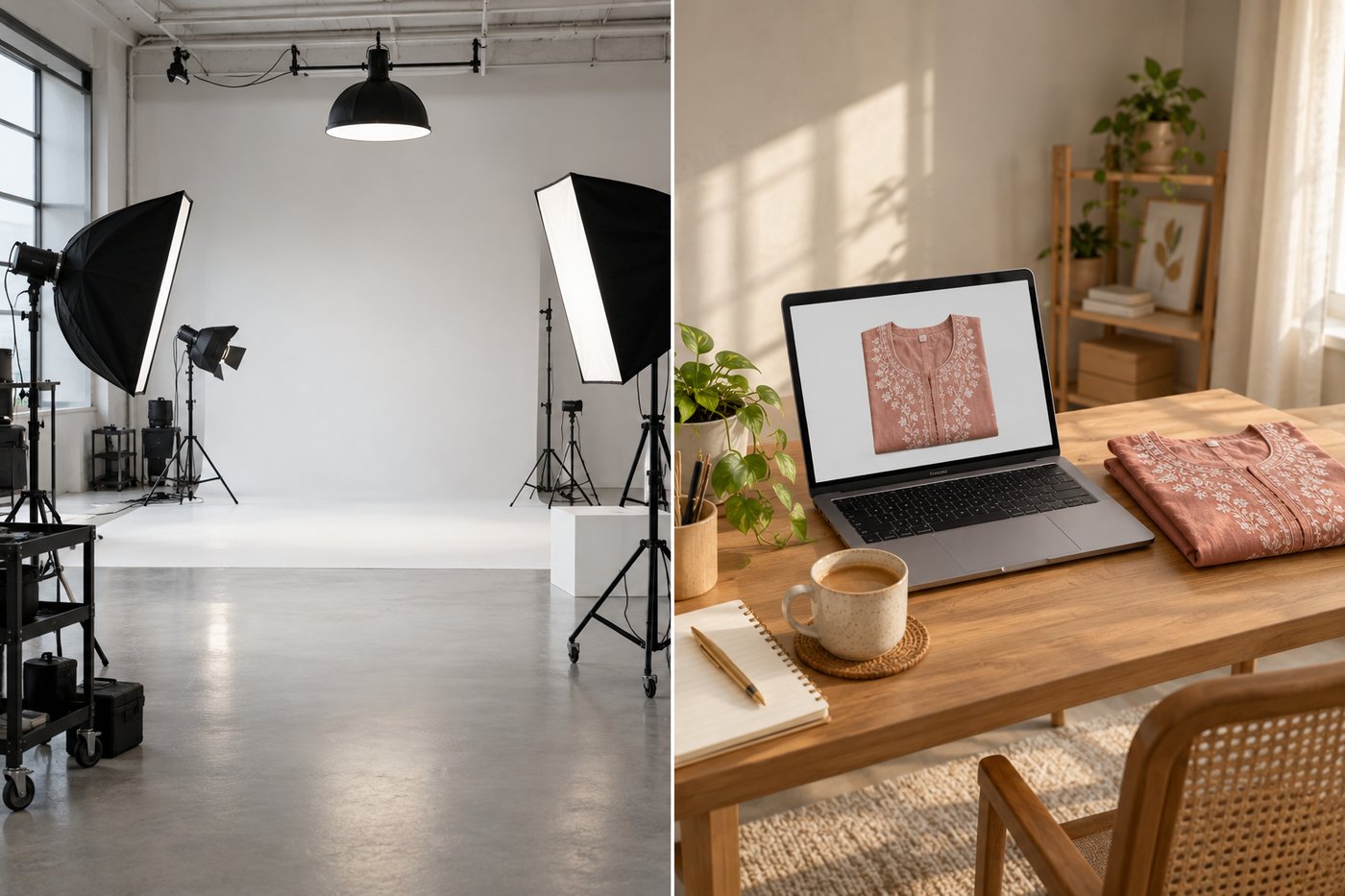
If you run a fashion brand in India — whether you sell sarees on Meesho, kurtas on Myntra, or streetwear on your own D2C store — you already know the pain. Getting professional product photography is expensive, slow, and hard to scale.
But have you ever broken down exactly where the money goes? Understanding the cost structure helps you see where AI tools like CatalogX can make the biggest impact.
The Real Cost of a Fashion Photoshoot
A typical product photoshoot for an Indian fashion brand involves five major cost centers:
- Models: Professional models in metros like Mumbai or Delhi charge anywhere from ₹5,000 to ₹50,000+ (about $600+) per day depending on experience and portfolio. Even "fresh face" models from agencies cost ₹3,000-8,000 per session.
- Studio rental: A decent studio with lighting equipment in a city like Bangalore or Mumbai runs ₹3,000-15,000 per day. Add backdrop changes and prop setups and costs climb further.
- Photographer: A professional fashion photographer charges ₹10,000-50,000 (about $120-$600) per day. Budget photographers exist, but the quality difference is visible — and your product images are your storefront.
- Styling & makeup: Hair and makeup artists add ₹3,000-10,000 per session. Stylists who handle garment prep, steaming, and on-set adjustments cost extra.
- Post-production: Color correction, background removal, retouching, resizing for different platforms — this alone can cost ₹50-200 (about $0.60-$2.40) per image when outsourced.
The Hidden Costs Nobody Talks About
Beyond the direct expenses, there are hidden costs that make traditional photography even more painful:
- Time: Coordinating schedules between the model, photographer, and studio can take weeks. A single shoot day might only produce 30-40 usable images after editing.
- Reshoots: Garments that don't fit the model properly, lighting issues, or creative direction changes mean reshoots — at full cost.
- Consistency: If you use different models or photographers across sessions, your catalog looks inconsistent. Customers notice.
- Speed to market: New inventory sitting in your warehouse while you wait for photoshoot slots is money losing value by the day. Fast fashion brands need images within days of production, not weeks.
Upload your garment and get a studio-quality AI mockup in 30 seconds. 5 free credits, no card needed.
Try Free Now →
Why Small and Mid-Size Brands Are Hit Hardest
Large fashion houses can amortize photography costs across thousands of units. But a D2C brand launching 20 new designs a month? Or a saree seller on Amazon with 200+ SKUs? The per-unit photography cost becomes a serious margin killer.
Many small brands resort to flat-lay images, hanger shots, or low-quality selfie-style photos. These "save money" in the short term but cost sales — conversion rates for flat-lay images are significantly lower than model shots on most platforms.
How AI Is Changing the Math
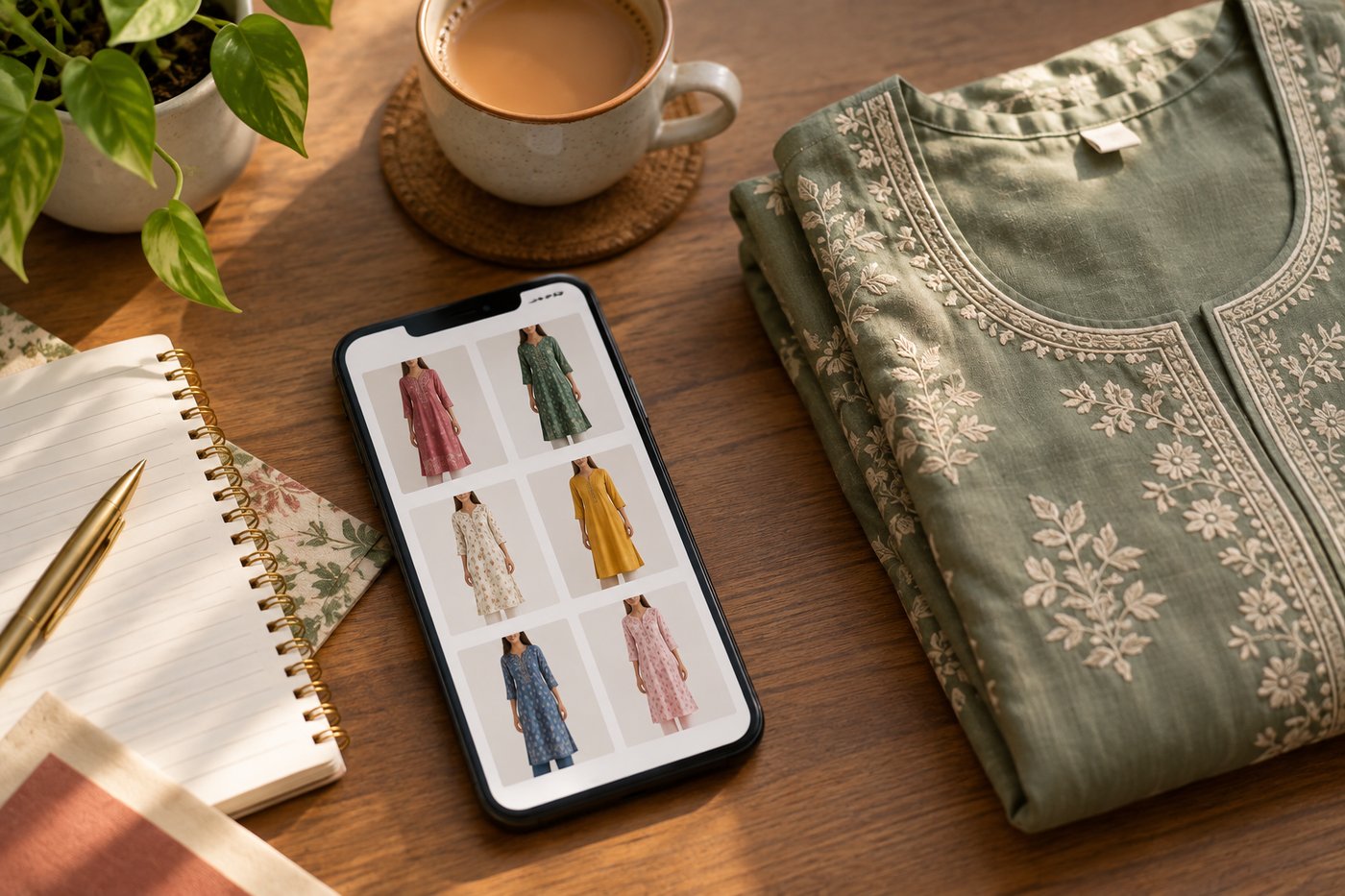
AI-powered tools like CatalogX are fundamentally changing the cost structure of fashion product photography:
- No model needed: Upload a garment photo and a model reference image. AI generates a photorealistic mockup of the model wearing your garment.
- No studio needed: Choose from 20+ backgrounds — studio white, outdoor, urban, festive — all generated by AI.
- No photographer needed: Select your pose, camera angle, and lighting. The AI handles composition.
- No post-production: Images come out ready to use. No retouching, no background removal, no resizing delays.
- Speed: 30 seconds per image vs. weeks of coordination. A 50-SKU catalog can be done in under an hour.
When Traditional Photography Still Makes Sense
AI mockups aren't replacing photography entirely — yet. There are scenarios where a real photoshoot still has the edge:
- Brand campaign imagery: For hero banners, lookbooks, and editorial content where a specific artistic vision matters.
- Complex styling: Multi-layered outfits with specific accessory placement, draping styles, or action poses.
- Video content: AI mockups are currently static images. Product videos still need real models.
But for the bread-and-butter of e-commerce — product listing images across poses and backgrounds — AI is already delivering quality that's indistinguishable from real photography at a fraction of the cost.
The Bottom Line
Product photography is expensive because it involves coordinating multiple skilled professionals, physical spaces, and time-intensive post-production. For fashion brands operating on tight margins, this cost structure doesn't scale.
AI tools aren't just "cheaper photography." They're a fundamentally different approach that decouples product imaging from physical logistics. The brands that adopt this shift early will have a significant cost advantage as the market catches up.
Related Articles
- Flat-Lay vs Model Shots: Which Sells More?
- How to Photograph Sarees and Kurtas Without a Model
- Choosing the Right Pose, Angle and Background for Your Product Photos
Frequently Asked Questions
Fashion product photography involves coordinating multiple skilled professionals (photographer, model, stylist, editor), renting studio space with specialized equipment, and time-intensive post-production work. In India, a single day's shoot costs Rs 15,000-50,000 (about $180-$600) and produces 30-50 final images, making per-image costs Rs 500-2,000 (about $6-$24).
A typical fashion photoshoot in India costs Rs 15,000-50,000 (about $180-$600) per day. This includes model fees (Rs 5,000-15,000, about $60-$180), studio rental (Rs 3,000-8,000, about $36-$95), photographer (Rs 5,000-20,000, about $60-$240), and post-production (Rs 200-500 (about $2.40-$6) per image). For a 100-SKU catalog with 4-5 images each, expect total costs of Rs 2-5 lakh (about $2,400-$6,000)s.
Use AI product photo generators like CatalogX that create photorealistic model-on images from flat-lay garment photos for Rs 15-40 (about $0.20-$0.50) per image. This eliminates studio, model, and photographer costs entirely. Free tools for background removal and image upscaling further reduce post-production expenses by 90-95%.
For e-commerce product listings on marketplaces like Amazon, Etsy, Shopify, Flipkart and Myntra, AI-generated images are comparable to traditional photography in quality and conversion performance. AI excels at consistent lighting and backgrounds across large catalogs. Traditional photography still wins for luxury editorial content and extreme close-up detail shots.
Hidden costs include re-shoots when marketplace QC rejects images, post-production editing for background cleanup and color correction, coordination time for scheduling models and studios, travel costs to metro cities for quality studios, and lost revenue from delayed listings while waiting for photos to be ready.