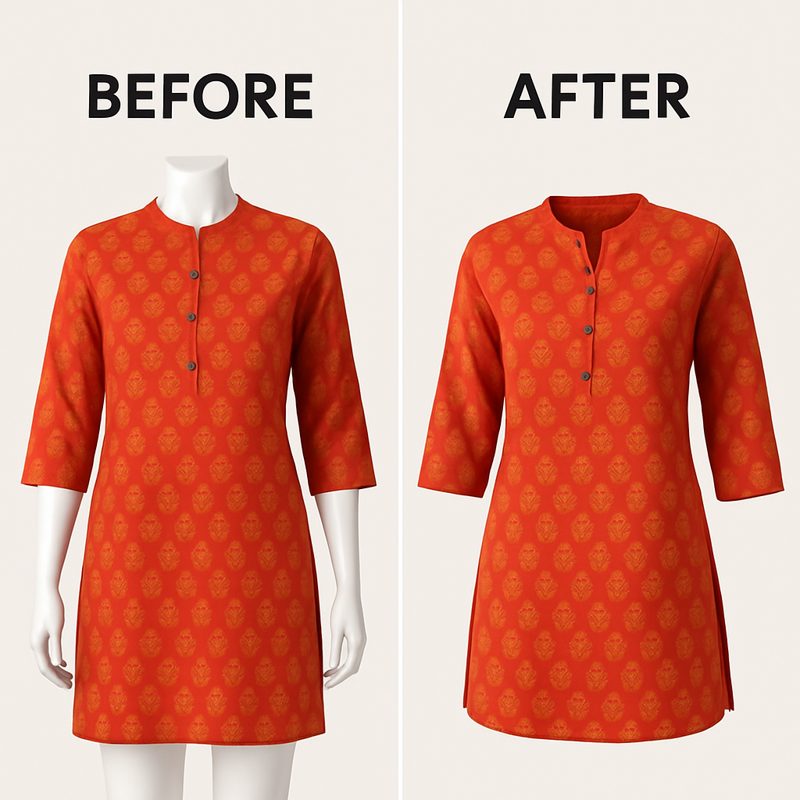
Ghost mannequin photography — also called the invisible mannequin effect — costs roughly $8 to $25 per garment through a retouching agency, or $12.99 to $29 a month through an AI tool that does it automatically. The effect shows a garment holding its own shape with no visible model or mannequin, including the inside of the collar and cuffs. It is made by photographing the garment twice, then compositing the two shots; AI tools now do the same reconstruction from a single photo.
What is ghost mannequin photography?
Ghost mannequin photography is a product-photography technique that shows a garment with its three-dimensional shape intact but no visible person or mannequin supporting it. The jacket has shoulders. The shirt has a collar that curves the way a collar curves on a body. But there is nobody inside it.
It is called the invisible mannequin effect, the hollow man effect, or 3D ghost mannequin — all the same thing. Retailers use it because it sits in a useful middle ground: more informative than a flat-lay, cheaper and more neutral than a model shot, and consistent enough to run across a hundred SKUs without the catalog looking like it was shot by five different people.
The defining detail — and the one that separates real ghost mannequin work from a background removal — is the neck join. In a proper ghost mannequin image you can see the inside back of the collar, as though you were looking down into the garment. That interior is not visible in any single photograph of a garment on a mannequin, because the mannequin's neck is in the way. It has to be composited in from a second shot.
How is the invisible mannequin effect actually made?
The traditional method is a two-shot composite, and understanding it explains why the technique costs what it costs.
- Shot one — the garment on the mannequin. The garment is dressed on a mannequin, steamed, pinned at the back so it sits taut, and lit. This is the shot that carries the shape.
- Shot two — the interior. The garment is turned so the inside of the collar, the back neck label area, or the inside of a cuff faces the camera. On some setups this means using a magnetic or collapsible mannequin whose neck section lifts out.
- Compositing. A retoucher masks the mannequin out of shot one, then patches the interior from shot two into the neck opening, matching perspective, colour and grain. Sleeve openings and open jackets get the same treatment.
That third step is skilled manual work, and it is why per-garment pricing exists at all. A plain t-shirt might take a retoucher four minutes. A lined blazer with an open front, visible interior lining and a vent takes twenty or more.
What does ghost mannequin photography cost in 2026?
Costs split into three tiers, and the gap between them is large.
| Route | Typical cost | Turnaround | What you need to supply |
|---|---|---|---|
| Full-service studio (shoot + retouch) | $40–$150 per garment | 1–3 weeks | The physical garment, shipped |
| Retouching agency (you shoot) | $8–$25 per garment | 24–72 hours | Two photos per garment, correctly shot |
| Offshore bulk retouching | $2–$6 per garment | 48–96 hours | Two photos, plus tolerance for variable quality |
| AI tool (subscription) | $12.99–$29 per month, often unlimited | Seconds | One photo |
The catch in the agency tiers is the phrase correctly shot. Agencies quote per garment on the assumption you send them a usable pair of images. If your second shot does not actually show the collar interior, you get back a guess, and the revision round is billable. For a seller shooting on a phone in a back room, the real cost of the $8 tier is closer to $8 plus a reshoot on a third of the catalog.
This is the arithmetic that pushes most small sellers toward AI: not that $8 is expensive in isolation, but that 200 SKUs at $8 is $1,600 and three weeks of coordination, against a monthly subscription and an afternoon.
Which AI ghost mannequin tools are worth using?
Seven tools that can produce the effect, with what each is actually for. Pricing read 22 September 2026.
| Tool | Pricing | Best for | Main limitation |
|---|---|---|---|
| CatalogX | From ₹299 / 5 free credits | Sellers who also want on-model shots and marketplace export | Built India-first; US model library is newer |
| Photoroom | $12.99/mo Pro, $99/mo batch | General product photography across categories | Not fashion-first — ghost mannequin is one feature among many |
| Rewarx Studio | $29/mo flat | High-volume batch with white-background compliance | Thin public evidence of testing behind the claims |
| WearView | Quote-based | Front-and-back mannequin removal | Ranks its own product first in its own comparison content |
| Photta | Under $1 per image | Per-image pricing with no subscription | Per-image adds up fast above ~50 SKUs |
| PixFocal | Flat monthly | Unlimited volume, same-day delivery | Service model, not self-serve software |
| PixPretty | Free tier available | Trying the effect before paying | Free-tier output resolution is limited |
When is a ghost mannequin the wrong choice?
Ghost mannequin is not the default answer for fashion, and treating it as one costs sales.
- Drape-led garments. Sarees, dupattas, maxi dresses and anything whose selling point is how it falls on a body lose most of their appeal hollow. A ghost mannequin saree is a picture of fabric, not of a saree.
- Fit-critical categories. Denim, tailoring and activewear sell on fit. Buyers want to see rise, break and stretch on a body, and a hollow garment answers none of it.
- Marketplaces that require a model. Amazon's apparel guidelines push hard toward a standing model on the main image for many clothing categories. Ghost mannequin can be perfectly good for the secondary slots and wrong for the hero.
Where it genuinely wins: structured outerwear, shirting, knitwear, kidswear, and any catalog where the buyer is comparing twenty similar items and needs them photographed identically. If you are choosing between approaches for a mixed catalog, our breakdown of flat-lay versus model shots covers the same trade-off from the other direction.
How CatalogX approaches this
CatalogX ships a dedicated ghost mannequin feature that reconstructs garment shape from a single photo rather than requiring the two-shot pair. The more common path our sellers take, though, is to skip the hollow look entirely and put the garment on a model, because that is what converts in fashion.
For that route the platform carries 114 AI models, 79 stock poses across three garment sets, and 111 backgrounds. Every render can be exported through 15 marketplace presets — Amazon, Amazon US, Flipkart, Myntra, Meesho, Ajio, Shopify, Etsy, eBay, Depop, Poshmark, TikTok Shop, Instagram, Instagram Square and WebP — at the exact canvas and subject ratio each platform expects. Marketplace Export is free on every plan, including the free tier.
Frequently asked questions
Background removal deletes what is behind the garment. Ghost mannequin removes the mannequin from inside the garment and reconstructs the parts it was hiding — most importantly the inside of the collar. A background removal on a mannequin shot leaves the mannequin visible at the neck.
Roughly $8 to $25 per garment through a retouching agency where you supply the photos, $40 to $150 through a full-service studio that shoots for you, and $2 to $6 through offshore bulk retouchers. AI tools replace per-garment pricing with a subscription, typically $12.99 to $29 a month.
Yes. Traditional ghost mannequin needs two shots because the collar interior is physically hidden in the first. AI tools reconstruct that interior generatively instead, so one photo is enough. The trade-off is that the interior is inferred rather than photographed, which matters if the lining is a selling point.
Ghost mannequin images are allowed on Amazon, Flipkart, Myntra and Meesho as secondary images. For the main image, Amazon's apparel guidelines steer many clothing categories toward a standing human model, so a ghost mannequin hero can underperform or be rejected depending on the category.
Poorly, as a rule. Sarees, lehengas and dupattas sell on drape and movement, and a hollow garment shows neither. Structured ethnic wear such as a men's bandhgala or a stiff kurta holds up better. For drape-led garments an on-model render is almost always the stronger listing image.
For the traditional two-shot method, a magnetic or collapsible mannequin whose neck and arm sections detach makes the second shot far easier, and those run roughly $150 to $600. If you are using an AI tool that works from a single photo, you do not need one at all.