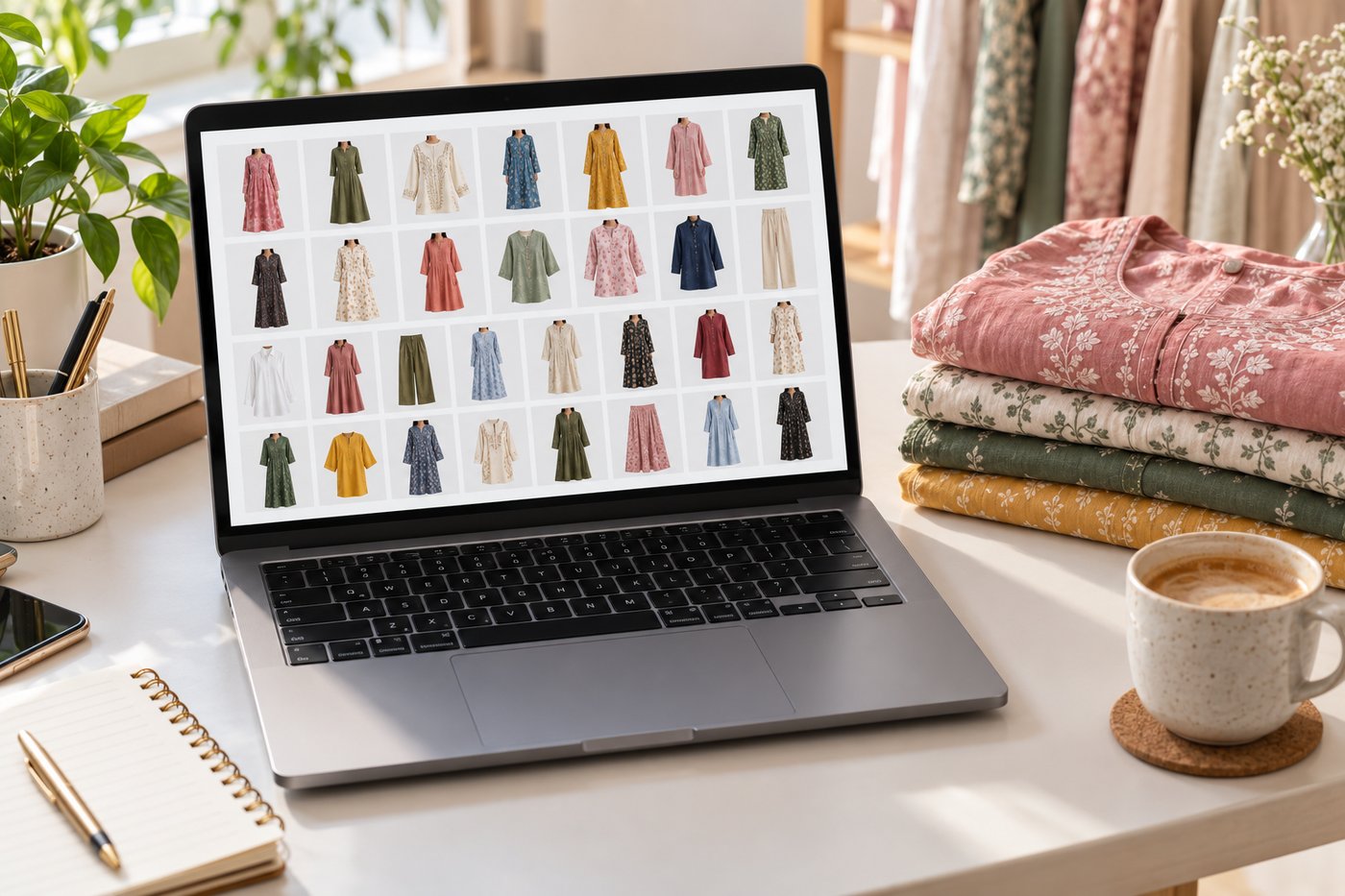
Search for "dress mockup generator" and most of the results were written for a different garment. They rank tools by how many blank templates are in the library, which is a sensible metric for a printed tee and an almost meaningless one for a dress. Nobody prints a graphic on an anarkali.
The Full-Length Problem
Dress imagery has one dominant technical constraint: the garment is tall. Everything difficult follows from that.
Because the dress runs from shoulder to ankle, the buyer evaluates the entire body of the image at once. Where does the hem land relative to the calf? Does the waist seam sit at the natural waist or drop below it? Does an A-line actually flare, or does it hang like a column? Is the slit functional or decorative? None of these questions can be answered by a close crop, which is why a chest-up mockup that works fine for a tee is useless here.
Length also makes returns expensive. Apparel return rates in India run high, and for dresses the recurring complaint is not colour but fit and length — the piece arrived shorter, longer, tighter or flatter than the photograph implied. An image that misrepresents drape does not just fail to convert; it converts and then reverses, taking shipping both ways with it.
So the evaluation criteria for dress tooling are not the ones you would use for a printed garment. They are: does it produce a full-length frame, does it keep the hem where it belongs, does it reproduce the fabric's weight and fall, and can it do that at a resolution and ratio the marketplace will accept.
Comparison Grid
Seven routes to a dress image, including one that involves no software at all. All descriptions reflect our understanding as of August 2026; capabilities in this space move quickly, so verify anything decision-critical with the vendor directly.
| Criterion | CatalogX | FASHN.ai | Botika | VModel.AI | ZMO.AI | Placeit | Studio photoshoot |
|---|---|---|---|---|---|---|---|
| Approach | AI virtual try-on for catalogues | AI virtual try-on | AI fashion imagery for brands | AI model swap and generation | AI image generation and editing | Pre-shot template overlay | Camera, model, studio |
| Starts from your real dress | Yes | Yes | Yes | Yes | Yes, with editing | No, artwork only | Yes, physically |
| Full-length on-model frame | Yes | Yes | Yes | Yes | Varies by workflow | Only if a template exists | Yes |
| Flat lay or hanger output | Used as input | Used as input | Used as input | Used as input | Yes, editable scenes | Yes | Yes, shot separately |
| Hem, drape and flare accuracy | Follows the garment | Follows the garment | Follows the garment | Follows the garment | Depends on prompt and edits | Fixed by the template | Ground truth |
| Indian ethnic dress silhouettes | Built for them: anarkali, gown, kurti-dress, lehenga-choli | Western-first, some ethnic capability | Western retail oriented | General purpose | General purpose | Effectively absent | Whatever you style |
| Western dress silhouettes | Yes | Strong | Strong | Yes | Yes | Limited templates | Yes |
| Indian model library | Yes, across skin tones and body types | Limited | Limited | Varies | Varies | Western template models | Whoever you cast |
| Batch or catalogue runs | Yes | API-friendly | Yes | Yes | Yes | No, one at a time | Yes, but a whole day per set |
| Output resolution | Listing-grade with HD upscale | Listing-grade | Listing-grade | Listing-grade | Varies by plan | Capped by template | Whatever the camera shoots |
| Marketplace ratio presets (1:1 and 3:4) | Amazon, Flipkart, Myntra, Meesho | Manual cropping | Western storefront oriented | Manual cropping | Manual cropping | Generic social sizes | Cropped in post |
| Background removal included | Yes | Handled by generation | Handled by generation | Usually | Yes | No | Retouching cost |
| Free access to evaluate | Yes, see pricing | Free credits typically offered | Trial-style access | Free credits typically offered | Free tier typically offered | Limited free tier | None |
| Billing currency | INR | USD | USD | USD | USD | USD | INR, invoiced per shoot |
| Learning curve | Low | Low, lower still with the API | Low to medium | Medium, prompt-dependent | Medium, prompt-dependent | Low | High, it is a production |
| Turnaround per image | Under a minute | Under a minute | Minutes | Minutes | Minutes | Minutes | Days, including retouching |
Why Template Libraries Barely Apply
It is worth being blunt about the category most listicles put at the top. Overlay libraries — the kind that hold thousands of pre-shot photographs and warp your artwork onto a print area — solve a problem dresses do not have. There is no print area on a wrap dress. There is nothing to overlay.
That is not a criticism of those products, which do their actual job well. It is a category mismatch. We included Placeit in the grid because sellers keep encountering it in search results for this query and deserve a clear answer about whether it fits, and the answer for a finished dress is that it does not. Where it does earn its keep is adjacent work: a lifestyle banner, an Instagram carousel frame, a logo animation, a sale graphic. Our CatalogX vs Placeit page goes deeper into that boundary.
The tools that genuinely address dresses are generative. They begin from a photograph of the garment you already own and build a wearer around it. Within that group the differences are about training focus, geography, throughput and workflow rather than about fundamental capability.
The Options in Detail
CatalogX
CatalogX is an AI try-on product built around the Indian seller's catalogue rather than around a western retail workflow. You photograph the dress — flat on a bed, on a hanger, on a mannequin — select a model and pose, and receive a full-length photorealistic frame with the garment's own colour, fall and embellishment carried through.
Where it fits dresses specifically: ethnic silhouettes are first-class, so anarkali flare, gown trains, kurti-dress lengths and lehenga-choli volume are handled rather than approximated. The model library covers Indian skin tones and body types, which matters more for a full-length frame than for a cropped one because the whole figure is visible. Marketplace export produces the 3:4 portrait Myntra requires and the 1:1 square Amazon and Flipkart expect without manual cropping, and batch runs make a seasonal catalogue refresh a single sitting.
Where it will frustrate you: it has no template library, so it is not the tool for previewing artwork on a blank. Very sheer or heavily mirror-worked fabrics remain hard for every generative system, ours included, and are worth a physical shoot when they are hero pieces. And the output is only as good as the input photograph; a dress shot with the hem out of frame cannot have its hem invented.
Pricing: billed in INR. See catalogx.app/pricing for current details.
FASHN.ai
FASHN.ai is a well-regarded virtual try-on product with a strong reputation for fidelity on western apparel and a developer-friendly posture. If you have engineering capacity and want try-on embedded in your own pipeline or storefront, the API-first design is a real advantage that most competitors do not match.
Genuine strengths: output quality on standard western dress silhouettes, a clean and fast interface, and integration flexibility. For a D2C brand with a technical team, this is a serious contender.
Limits for an Indian dress catalogue: the model library and training emphasis lean western, there are no Indian marketplace crop presets, and billing is in dollars. Heavy ethnic construction is outside its primary focus. We have a fuller side-by-side at CatalogX vs FASHN.ai.
Botika
Botika targets apparel brands replacing recurring studio work with generated imagery, and it is a mature product for that use case. Brands with large western catalogues and consistent garment types tend to get good, repeatable output.
Genuine strengths: apparel specialisation, throughput designed for brand-scale catalogues, and consistent styling across a set — which matters when a listing grid has to look coherent.
Limits for dresses in India: the western retail orientation shows in model selection and styling defaults, ethnic silhouettes are not the focus, pricing is quoted in dollars and often per volume, and Indian marketplace formatting is left to you. See CatalogX vs Botika.
VModel.AI
VModel.AI sits in the AI-model-generation space: swap the person in an existing photograph, or generate a model wearing a supplied garment. It is a flexible, general-purpose tool rather than a fashion-catalogue pipeline. Status note (September 2026): VModel has pivoted toward a model-hosting API marketplace and its fashion try-on pages no longer resolve — verify the product still exists before shortlisting it.
Genuine strengths: flexibility, quick iteration, and usefulness beyond a single garment category. Handy when you need a range of looks rather than a standardised catalogue.
Limits: results vary more between runs than with a purpose-built catalogue tool, output framing and cropping are your responsibility, and there is no Indian marketplace tooling. Confirm current credit allowances and plans on their site rather than trusting any third-party summary, including this one.
ZMO.AI
ZMO.AI is a broader AI image generation and editing platform with product and fashion imagery among its use cases. Treat it as a creative suite that can produce model imagery rather than as a dedicated try-on engine. Status note (September 2026): we could not verify ZMO.AI's fashion product as live or maintained — confirm on their site before relying on it.
Genuine strengths: breadth. Backgrounds, scenes, editing and generation in one place, which suits a marketing team producing varied creative rather than a seller producing 200 consistent listing images.
Limits for dresses: consistency across a large catalogue is harder to hold, results depend meaningfully on prompting skill, and there is no marketplace-specific export. For hero and campaign imagery it is capable; for routine listing throughput, a catalogue-oriented tool is less work.
Placeit
Covered above as a category outlier. Excellent at what it was built for — overlaying artwork onto pre-shot blanks, plus a wide library of non-apparel mockups, video templates and design assets — and structurally unable to represent a finished dress. Worth a subscription for marketing collateral; not the tool that produces your listing hero.
A Real Photoshoot
Still the quality ceiling, and still the right call for some work. A photographer, a stylist and a cast model give you creative direction no generative tool offers, and for heavily embellished couture or unusual construction, a camera remains the most reliable instrument.
Genuine strengths: absolute accuracy, art direction, movement, editorial styling, and imagery you own outright with no ambiguity.
Limits: cost and calendar. A shoot carries model fees, studio hire, styling, assistants, travel and retouching whether you photograph five dresses or fifty, and the cycle from booking to delivered files typically runs into weeks. That economics problem is what pushed catalogue photography towards generation in the first place; we broke the numbers down in AI try-on vs a photoshoot: the real cost in India, and there is a dedicated CatalogX vs hiring a photographer comparison too.
Anarkalis, Gowns and Kurti-Dresses
If your range is Indian, "dress" covers a set of silhouettes that western-trained tools have simply seen less of. Each carries a specific failure mode worth testing for:
- Anarkali. The flare below the empire waist is the whole garment. Tools that under-model volume return a straight column and the piece loses its identity.
- Gowns and floor-length pieces. The hem must meet the floor convincingly. Watch for a hem that floats, or feet that disappear into fabric that is not actually there.
- Kurti-dresses. Length is the product decision the buyer is making. Knee, mid-calf and ankle must be visibly distinct. Our kurti catalogue guide covers how to shoot and present these.
- Lehenga-choli sets. Two garments plus a dupatta, so the tool has to keep three pieces coherent simultaneously. The dupatta is where most systems struggle; the same draping challenges we discuss in the saree draping guide apply.
- Heavy embellishment. Zari, mirror work, sequins and heavy embroidery reflect light in ways generative models find difficult. Shoot these in flat, even light and inspect the result closely before publishing.
The practical rule: test the flare and the hem first. If a tool holds those two on your hardest piece, the rest of your catalogue will be comfortable.
Aspect Ratios and Rejections
Dress images fail marketplace checks in a specific, predictable way, and it is almost always the crop.
Myntra wants a 3:4 portrait frame with the model visible head to toe, generally at 1080x1440 pixels or better. That is a natural fit for a dress. Amazon India and Flipkart want a 1:1 square primary image, usually from 1000 pixels upward on a white or near-white background — and a square is a hostile shape for a tall garment. Squeeze a floor-length gown into 1:1 and either the model shrinks until the fabric detail is unreadable, or you crop the hem and lose the length information the buyer needs.
The workable sequence is to generate tall, then derive the square. Produce the 3:4 portrait at full resolution first, then crop a square from it that keeps the garment filling the frame properly. Doing it the other way round means upscaling a crop, and it shows. Tools with built-in marketplace presets do this for you; with the others, build it into your own process. Our Myntra five-image guide covers the complete image set a fashion listing needs.
How These Are Priced
We are describing pricing structures rather than quoting numbers, because plans in this category are revised often and a stale figure would do more harm than good. As of August 2026 you will encounter four models:
- Credits consumed per generation. Common across the AI try-on tools. Your real cost per usable image is higher than the sticker rate because you will discard some outputs, so estimate two to three generations per published image when you budget.
- Monthly subscription with an image allowance. Predictable, but check what happens when you exceed the allowance mid-season.
- Volume or enterprise quotes. Typical for brand-focused vendors. Sensible above a few hundred SKUs; heavy for a boutique.
- Per-project invoicing. Photographers. Priced by the day or the shoot, effectively fixed regardless of output count.
Two factors matter more than the headline rate for an Indian seller. Dollar-denominated billing adds conversion cost and payment friction on every cycle. And discard rate quietly dominates unit economics: a tool with a higher per-image price but a much better first-attempt hit rate on your specific garments is usually cheaper in practice. Run the same five dresses through your shortlist and count how many generations each needed before you had something publishable. CatalogX bills in INR; current rates are at catalogx.app/pricing.
Throughput and Who Runs It
Ask who in your business will actually operate the tool every week. The answer changes the shortlist more than any feature does.
- Catalogue tools (CatalogX, Botika) are designed for a non-technical operator running many SKUs in a repeatable way. Consistency across the set is the design goal.
- API-first tools (FASHN.ai) reward a technical team and are excellent when generation needs to sit inside an existing pipeline. Without engineering capacity that advantage goes unused.
- Prompt-driven suites (ZMO.AI, and VModel.AI to a degree) reward someone who enjoys iterating on prompts. That person produces striking work and also produces variance, which is a problem for a uniform listing grid.
- A photoshoot requires coordination — booking, sampling, styling, review — that lands on a person for days at a time.
For a small team, the reliability of a repeatable workflow is usually worth more than the highest achievable single image.
A Decision Shortlist
- Indian ethnic dresses, marketplace listings, small team. CatalogX. Ethnic silhouettes, Indian models, INR billing and marketplace crops are the specific gaps the western tools leave open.
- Western dresses, D2C site, engineering resource available. FASHN.ai, with the API doing the heavy lifting.
- Established apparel brand, large catalogue, replacing studio days. Botika, trialled against one other generative tool on your hardest SKUs.
- Varied creative needs beyond listings. A general creative suite — with the understanding that consistency needs managing, and noting the September 2026 status caveats on ZMO.AI and VModel.AI above.
- Marketing collateral, banners and social graphics. Placeit, alongside whichever tool makes your listing images.
- Couture, heavy embellishment or a seasonal campaign. A real photoshoot. Some pieces deserve a camera.
The pattern we see most often among sellers who have settled into a rhythm is a hybrid: one physical shoot per season for the hero pieces and the brand imagery, generation for the long tail of routine listings, and a design tool for the marketing layer on top. That splits spend where it earns the most and stops a photographer's invoice from scaling with catalogue size.
Related Reading
- Best Shirt Mockup Generators Compared (2026)
- AI Try-On vs Photoshoot: The Real Cost in India
- AI Saree Draping and Virtual Try-On
- Kurti Catalogue Design Ideas That Sell
Frequently Asked Questions
A t-shirt occupies a small, flat, forgiving area of the frame. A dress runs from shoulder to ankle, so the image has to be believable across the whole body: how the fabric falls from the waist, where the hem lands, how a flare or a slit behaves in motion, and how the silhouette reads in profile. Overlay-style template mockups have almost no vocabulary for any of that, which is why the useful tools for dresses are generative rather than compositing.
Yes. Modern virtual try-on models take a garment photograph shot flat, on a hanger or on a mannequin and synthesise a model wearing it head to toe. Quality depends heavily on the input: shoot the dress evenly lit, uncreased and fully in frame including the hem, and the generated result will hold its length and drape far more accurately.
Coverage is uneven. Tools built around western retail catalogues handle sheath, shift, wrap and midi dresses well but have less exposure to anarkali flare, dupatta placement, heavy lehenga-choli volume or churidar silhouettes. CatalogX is built specifically for the Indian catalogue and handles ethnic silhouettes alongside western ones. If ethnic wear is most of your range, test a heavily flared piece before you commit to any tool.
Myntra expects a 3:4 portrait frame with the model fully visible from head to toe, typically at 1080x1440 pixels or better. Amazon India and Flipkart expect a 1:1 square primary image, generally from 1000 pixels upward, on a white or near-white background. Because a dress is tall, the square crop is the awkward one, so generate at portrait resolution first and crop down rather than the other way round.
Per image, almost always yes, because a physical shoot carries model fees, studio hire, a stylist, travel and a full day of coordination regardless of how many SKUs you shoot. A studio day still wins on absolute creative control and on pieces with unusual construction or heavy embellishment. Many sellers now shoot one campaign set physically each season and generate the routine catalogue images.
The major Indian marketplaces judge images against their technical and accuracy specifications rather than against how the image was produced, so photorealistic AI-generated model images are generally accepted provided the garment shown matches the product being sold. The risk is not the technology, it is misrepresentation: never generate a colour, length or embellishment the buyer will not receive.
About this comparison. Written 9 August 2026; last reviewed 15 September 2026. This is a fast-moving category and vendor capabilities, plans and prices change frequently. We have deliberately described pricing structures instead of quoting figures, and where we were not certain of a competitor's current behaviour we have said that it varies rather than inventing a specific. Please confirm anything decision-critical on the vendor's own website. FASHN.ai, Botika, VModel.AI, ZMO.AI, Placeit and Envato are trademarks of their respective owners; CatalogX is not affiliated with, endorsed by or sponsored by any of them. This article is published by CatalogX, which is one of the options compared, and we have tried to state each alternative's real strengths and our own product's real limitations. Spotted something inaccurate? Tell us via our contact page and we will correct it.