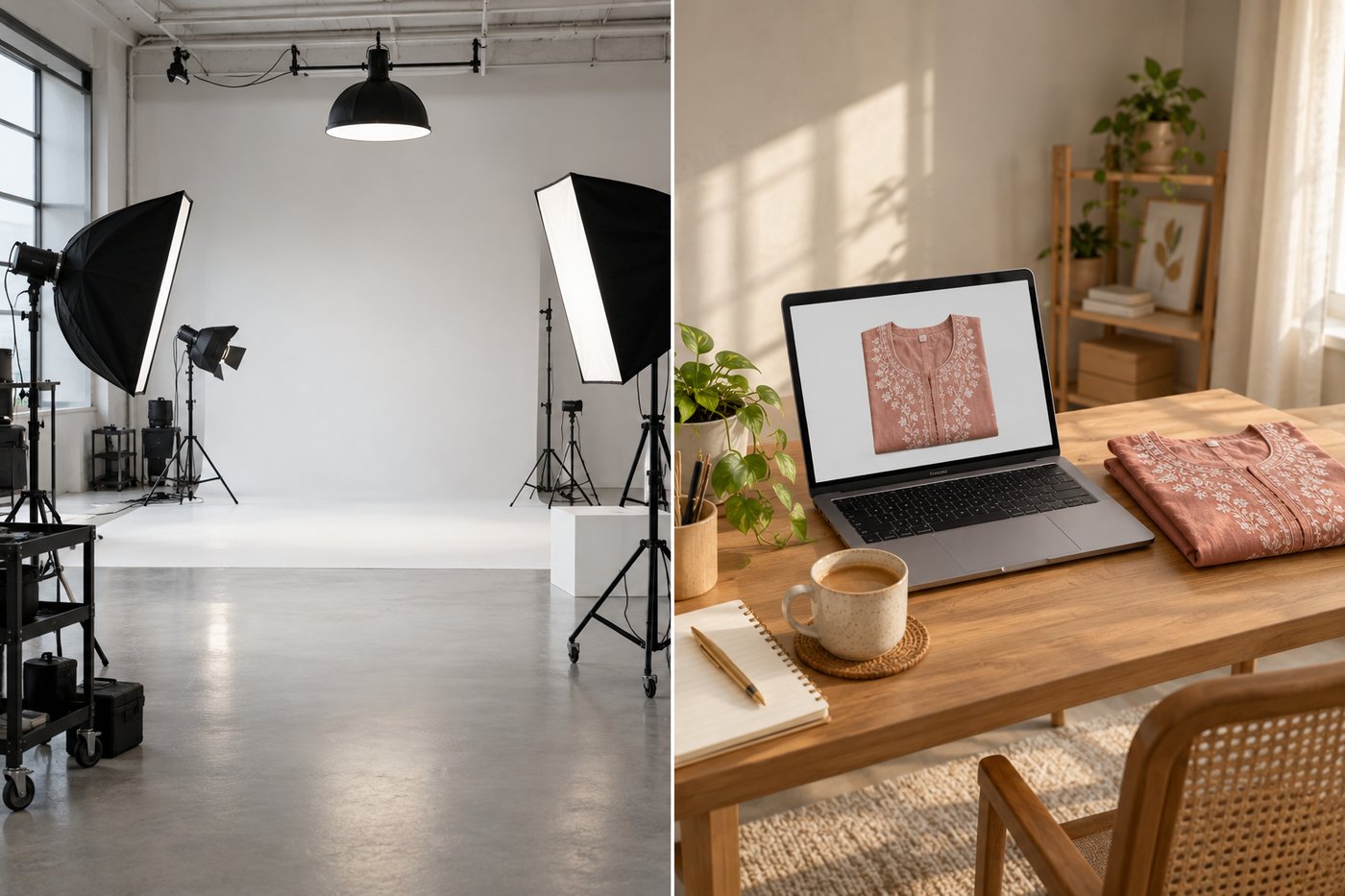
AI virtual try-on costs ₹12–15 per image compared to Rs.5,000-20,000 per traditional photoshoot session in India. For a fashion seller generating 50 product images per month, AI try-on reduces photography costs by 90-95% while delivering marketplace-compliant model shots in seconds instead of days.
That is the headline number. But if you are an Indian fashion seller trying to decide between hiring a photographer or using an AI tool like CatalogX virtual try-on, you need more than a headline. You need a detailed breakdown of every cost involved, a clear understanding of what you get for your money, and an honest assessment of where each approach wins and loses.
This article provides exactly that. We break down every line item in both traditional photography and AI try-on, compare costs at different volumes, calculate the exact breakeven point, and share what Indian sellers who have made the switch are actually experiencing. All prices are in INR and reflect 2026 market rates across tier-1 and tier-2 Indian cities.
How Much Does a Fashion Photoshoot Cost in India?
The cost of a fashion photoshoot in India varies significantly based on your city, the quality of professionals you hire, and the number of garments you need to shoot. But every shoot involves the same core cost centers: a model, a photographer, a studio, and post-production editing. Here is a detailed breakdown based on current 2026 market rates, gathered from conversations with photographers and studios across Mumbai, Delhi, Bangalore, Jaipur, and Surat.
| Cost Component | Budget Range | Mid-Range | Premium |
|---|---|---|---|
| Model fees (per day) | Rs.2,000 - 4,000 | Rs.5,000 - 8,000 | Rs.8,000 - 10,000+ |
| Photographer (per day) | Rs.3,000 - 5,000 | Rs.6,000 - 10,000 | Rs.10,000 - 15,000+ |
| Studio rental (per day) | Rs.1,500 - 2,500 | Rs.3,000 - 4,000 | Rs.4,000 - 5,000+ |
| Hair & makeup artist | Rs.1,500 - 2,500 | Rs.3,000 - 5,000 | Rs.5,000 - 8,000 |
| Styling / garment prep | In-house | Rs.1,000 - 2,000 | Rs.3,000 - 5,000 |
| Post-production (per image) | Rs.200 - 300 | Rs.300 - 400 | Rs.400 - 500+ |
| Total per shoot day | Rs.8,000 - 15,000 | Rs.18,000 - 30,000 | Rs.30,000 - 50,000+ |
A typical shoot day produces 20-40 final images after editing, depending on the complexity of garments, the number of outfit changes, and how quickly the team works. This means the effective per-image cost ranges from Rs.500 to Rs.2,000 when you divide the total shoot cost by usable output.
But the table above only captures the direct costs. There are several hidden expenses that inflate the real cost of traditional photography significantly:
- Coordination time: Finding and booking a model, photographer, and studio whose schedules align can take 1-3 weeks. For sellers outside metro cities, this often means travel to Mumbai or Delhi, adding Rs.5,000-15,000 in transport and accommodation.
- Reshoots: If images do not meet marketplace requirements — wrong background shade, model cropped too tight, poor lighting consistency — you pay the full shoot cost again. Reshoot rates run 15-25% of total sessions for sellers new to marketplace specifications.
- Garment logistics: Shipping garments to the shoot location and back, especially for sellers in tier-2 and tier-3 cities, adds Rs.500-2,000 per session and 3-5 days of transit time on each side.
- Opportunity cost: New inventory sitting in your warehouse without images cannot be listed. Every day without a listing is a day without sales. For fast fashion categories where trends move quickly, a two-week photography delay can mean the difference between catching a trend and missing it entirely.
- Consistency tax: Using different models or photographers across sessions makes your catalog look inconsistent. Customers notice when the same store has wildly different image styles. Maintaining consistency means booking the same team repeatedly, which limits your scheduling flexibility and bargaining power.
We covered many of these costs in detail in our earlier article on why product photography is so expensive for fashion brands. The bottom line: the true all-in cost of traditional fashion photography in India is 20-40% higher than the direct shoot costs suggest.
How Much Does AI Try-On Cost Per Image?
AI virtual try-on tools work on a fundamentally different cost model. There is no studio, no model, no photographer, and no post-production. You upload a garment image — a flat-lay, mannequin shot, or hanger photo — and the AI generates a photorealistic image of a model wearing your garment. The entire process takes 30-60 seconds.
CatalogX uses a credit-based pricing system. Each AI image generation uses one credit. Here is the complete pricing breakdown:
| Plan | Price | Credits | Cost Per Image |
|---|---|---|---|
| Free | Rs.0 | 5 credits total | Rs.0 (free) |
| Starter | Rs.299/month | 15 credits | Rs.20/image |
| Pro | Rs.849/month | 55 credits/month | ~Rs.14/image |
| Enterprise | Custom | Unlimited | Volume pricing |
Each generation costs 1 credit and is tuned for marketplace listing quality — sharp enough for hero images and zoom views on Flipkart, Myntra, and Amazon.
Beyond the per-image generation cost, CatalogX includes several tools at no additional credit cost on all plans:
- Background removal: Remove backgrounds from existing product photos — free, unlimited, no credits used.
- HD upscale: Upscale generated images to higher resolution — free on all paid plans.
- Marketplace export: One-click export in platform-specific formats for Flipkart, Myntra, Amazon, and Meesho — free on all plans.
These free tools are significant because they replace services that would otherwise cost Rs.50-200 per image if outsourced separately. A seller who previously paid Rs.100 per image for background removal across 200 images was spending Rs.20,000 per month on that alone — now it is free.
For a detailed look at the full pricing structure, see our pricing page.
Upload your garment and get a studio-quality AI model shot in 30 seconds. 5 free credits, no card needed.
Try Free Now →
How Do the Costs Compare Side by Side?
Here is where the numbers become stark. The following table compares total costs for traditional photography versus CatalogX AI try-on at different production volumes. For traditional photography, we use mid-range pricing (Rs.800 per image all-in, which is conservative for most Indian markets). For AI, we use the Pro plan (Rs.12 per image).
| Monthly Volume | Traditional Photoshoot | CatalogX AI Try-On | Savings | Savings % |
|---|---|---|---|---|
| 10 images | Rs.8,000 - 15,000 | Rs.299 (Starter) | Rs.7,700 - 14,700 | 96-98% |
| 55 images | Rs.40,000 - 75,000 | Rs.849 (Pro) | Rs.39,150 - 74,150 | 98-99% |
| 200 images | Rs.1,60,000 - 3,00,000 | Rs.3,396 (4x Pro) | Rs.1,56,600 - 2,96,600 | 98-99% |
| 500 images | Rs.4,00,000 - 7,50,000 | Custom Enterprise | Rs.3,90,000+ | 95%+ |
The difference is not incremental — it is an order of magnitude. A seller producing 55 images per month saves approximately Rs.40,000-74,000 every single month by switching to AI. Over a year, that is Rs.4.8-8.9 lakhs in savings — money that can be redirected to inventory, marketing, or expanding product lines.
But cost is only part of the equation. Time savings are equally dramatic:
| Factor | Traditional Photoshoot | CatalogX AI Try-On |
|---|---|---|
| Booking to shoot | 1-3 weeks | Instant |
| Shoot duration (50 garments) | 1-2 full days | Under 1 hour |
| Post-production | 3-7 days | None needed |
| Total time to listing-ready images | 2-4 weeks | Same day |
| Re-generation for marketplace rejection | Rebook entire shoot | 30 seconds |
For fast fashion sellers and seasonal categories, the time advantage is often more valuable than the cost savings. Being able to list new arrivals on the same day they arrive in your warehouse means catching trends at peak demand rather than listing after the trend has passed.
What About Quality? Does AI Match Studio Photography?
This is the question every seller asks before making the switch, and it deserves an honest answer. The quality comparison is not black and white — each method has strengths and weaknesses.
Where AI try-on matches or exceeds studio photography
- Consistency: AI produces images with identical lighting, composition, and style across your entire catalog. No variation between shoot days, different photographers, or different studios. Your product listing page looks cohesive and professional. This is arguably where AI has the biggest advantage — consistency in model shots directly impacts brand perception and conversion rates.
- Background quality: Studio white backgrounds from real shoots often have subtle variations — shadows, creases in the backdrop, slight color shifts. AI produces perfectly clean, uniform backgrounds that pass marketplace QC checks every time.
- Garment presentation: The AI is trained specifically on fashion photography and understands how different fabrics drape, how garments should fit at different points, and how light interacts with various materials. For standard e-commerce poses, the results are indistinguishable from professional photography to the average online shopper.
- Color accuracy: Fashion-specific AI tools like CatalogX preserve the exact colors of your source garment. This is critical for e-commerce — a customer who orders a maroon kurta and receives something that looks different from the listing image will return it. AI maintains color fidelity consistently.
- Scalability of poses and backgrounds: With a single garment upload, you can generate the same garment in multiple poses and on multiple backgrounds. A traditional shoot would require multiple outfit changes, set changes, and significantly more time for the same variety.
Where traditional photography still has an edge
- Fabric texture at extreme close-up: For premium fabrics where the weave, texture, or embroidery detail is a major selling point, real macro photography still captures these nuances better. AI generates textures that look accurate at standard viewing distances but may not hold up under pixel-level scrutiny.
- Complex multi-garment styling: Outfits that involve specific layering — a jacket over a kurta with a particular dupatta drape — are harder for AI to get exactly right. The more garments and accessories in a single image, the more likely you will need manual adjustments or multiple generations.
- Emotional and editorial impact: For brand storytelling — lookbooks, campaign imagery, social media hero posts — a real model in a real environment with a real photographer's creative vision produces something that AI cannot fully replicate. The intangible qualities of spontaneity, emotion, and artistic direction are difficult for AI to match.
- Specific body positioning: If you need a very particular pose or body angle that is not available in the AI tool's pose library, a real model can accommodate any direction. AI tools are limited to their pre-trained pose options.
The practical reality for most Indian e-commerce sellers is this: AI quality is more than sufficient for the 80-90% of images that serve as standard product listings. The question is not whether AI matches studio photography in every dimension — it is whether AI quality is good enough to drive sales on Flipkart, Myntra, Amazon, and Meesho. In 2026, the answer is overwhelmingly yes.
When Should You Still Use a Traditional Photoshoot?
Despite the cost and time advantages of AI, there are specific situations where investing in a traditional photoshoot remains the better choice:
- Hero and campaign imagery: Your homepage banner, your Instagram grid hero post, your seasonal campaign creative — these are the images that define your brand. They deserve real creative direction, real models, and real photography. AI images work for product listings; brand campaigns benefit from the authenticity and editorial quality of real shoots.
- High-fashion and luxury: If you sell designer lehengas at Rs.50,000+ per piece or premium silk sarees at Rs.20,000+, the photography cost is a tiny fraction of the product value. Luxury buyers expect and appreciate the quality signals that come with real editorial photography. The investment in a premium photoshoot reinforces the premium positioning of your product.
- Video content: AI try-on currently generates static images. If you need product videos — garment movement, fabric flow, model walking shots — you still need a real shoot. Video content is increasingly important on platforms like Instagram Reels and YouTube Shorts, and this is an area where AI has not yet caught up.
- Unique or complex poses: If your garment needs to be shown in a specific action — a sports bra during a yoga pose, a rain jacket in outdoor conditions, a bridal lehenga with a specific twirl — and that exact pose is not available in the AI tool, a real shoot gives you full control over the model's positioning.
- Catalogue and lookbook for wholesale: If you sell B2B and your buyers expect printed or PDF lookbooks with a particular editorial style, a cohesive professional shoot planned around a theme will serve this purpose better than AI-generated images.
The smart approach is a hybrid model: use AI for the volume work — standard product listings, marketplace images, and quick catalog updates — and reserve traditional photography for the high-impact creative work that builds your brand. This is exactly how the most cost-efficient fashion brands in India are operating in 2026.
How Many Images Before AI Pays for Itself? An ROI Calculator
Let us calculate the exact breakeven point for switching from traditional photography to AI try-on. We will use conservative mid-range numbers for traditional photography and CatalogX Pro plan pricing.
Traditional photography: Rs.800 per image (mid-range all-in cost including model, photographer, studio, editing)
CatalogX Pro plan: Rs.849/month for 55 credits (about Rs.14 per standard image)
Time value: Rs.500/hour for seller's own time (conservative for a business owner)
Scenario 1: Small seller — 20 images per month
Traditional cost: 20 images x Rs.800 = Rs.16,000 per month. Plus approximately 8 hours of coordination time (booking, travel, supervision, review) = Rs.4,000 in time value. Total: Rs.20,000 per month.
AI cost: CatalogX Starter pack: Rs.299 for 15 credits. Plus approximately 30 minutes of work (uploading and generating) = Rs.250 in time value. Total: Rs.549 per month.
Monthly savings: Rs.19,451. ROI from the first month.
Scenario 2: Growing seller — 60 images per month
Traditional cost: 60 images x Rs.800 = Rs.48,000 per month. Plus approximately 16 hours of coordination = Rs.8,000 in time value. Total: Rs.56,000 per month.
AI cost: CatalogX Pro plan: Rs.849 for 55 credits. Plus approximately 1.5 hours of work = Rs.750 in time value. Total: Rs.1,599 per month.
Monthly savings: Rs.54,401. Annual savings: Rs.6,52,812.
Scenario 3: High-volume seller — 200 images per month
Traditional cost: 200 images across 5-6 shoot days = Rs.1,60,000 - 2,40,000 per month. Plus coordination overhead for multiple shoots = Rs.15,000+ in time value. Total: Rs.1,75,000 - 2,55,000 per month.
AI cost: Enterprise pricing with volume discounts, estimated at Rs.5,000-10,000 per month. Plus approximately 5 hours of work = Rs.2,500. Total: Rs.7,500 - 12,500 per month.
Monthly savings: Rs.1,62,500 - 2,42,500. Annual savings: Rs.19.5 - 29.1 lakhs.
The ROI calculation becomes even more favorable when you account for factors that are harder to quantify: faster time-to-market letting you capture trending demand, consistency across your catalog improving brand perception, and the ability to experiment with different model looks and backgrounds without committing to a full shoot for each variation.
What Are Indian Sellers Saying About Switching to AI?
The numbers tell one story. Here is what sellers who have actually made the switch experience in practice:
— D2C kurta seller, Jaipur, 80+ SKUs
— Saree seller, Surat, 200+ SKUs on Myntra
— Fast fashion seller, Delhi, selling on Flipkart and Amazon
— Women's ethnic wear brand, Bangalore, 150+ SKUs
The consistent theme across sellers who have switched is that the initial skepticism about quality fades quickly once they see results with their own products. The cost and time savings are immediate and obvious, but the quality validation — seeing AI images perform as well as or better than traditional photos in actual marketplace performance — is what cements the decision.
How Do You Get Started with AI Try-On?
If the cost comparison has convinced you to try AI try-on for your fashion products, here is a practical roadmap to get started without any risk or upfront investment:
- Start with the free tier: Sign up at CatalogX with your Google account. You get 5 free credits immediately — no credit card, no commitment. Use these to test with your actual products before spending anything.
- Choose your best-selling garment: Pick a product you know well — one where you can easily compare the AI result against your existing photos or against how the garment actually looks when worn.
- Take a clean source photo: Lay the garment flat on a white or light surface, or photograph it on a mannequin. Good lighting (natural daylight works well) and a clean background significantly improve AI output quality. For specific tips on photographing different garment types, see our guide on getting started with AI product photos.
- Generate and compare: Upload the garment, select your garment type, choose a model and pose, and generate. Compare the result against your existing product images. Show both to a few customers or friends and ask which looks more professional.
- Scale based on results: If the quality meets your bar — and for most sellers it will — move to the Starter pack (Rs.299 for 20 images) or Pro plan (Rs.849/month for 55 images) and start replacing your traditional photography workflow.
The most common mistake sellers make is testing AI with their worst product photo as input. AI amplifies the quality of your source image — a well-lit, clean flat-lay produces dramatically better results than a wrinkled garment photographed in poor lighting. Invest 2-3 minutes in a proper source photo and the AI output will reflect that quality.
The Bigger Picture: What This Means for Indian Fashion E-Commerce
The shift from traditional photography to AI-generated product images is not just a cost optimization — it is a structural change in how Indian fashion e-commerce operates.
Consider the numbers at industry scale: the Indian fashion e-commerce market generates millions of product listings every year. If the average cost of photography drops from Rs.800 per image to Rs.12 per image, that is billions of rupees in aggregate savings flowing back to sellers — money that can be invested in better products, faster shipping, stronger brands, and ultimately better experiences for consumers.
More importantly, AI democratizes access to professional product imagery. A first-time seller in a tier-3 city who previously could not afford a single professional photoshoot can now create marketplace-quality listings for the cost of a cup of chai. The barrier to entry for fashion e-commerce drops dramatically, which means more competition, more choice for consumers, and a more vibrant marketplace overall.
For established sellers, the competitive advantage of professional photography — which was once a significant moat — erodes. The new differentiators become product quality, pricing, brand building, and customer service rather than simply having better photos than your competitors. This is ultimately healthier for the market.
The sellers who recognize this shift early and adapt their workflows accordingly will have a significant cost advantage during the transition period. Those who continue spending lakhs per year on traditional photography for standard product listings will find themselves at a growing disadvantage — not because their images are worse, but because their cost structure cannot compete with sellers producing equivalent-quality images at 5% of the cost.
The math does not lie. At Rs.12 per image versus Rs.800 per image, the question is not whether AI try-on makes financial sense — it is how quickly you can make the switch.