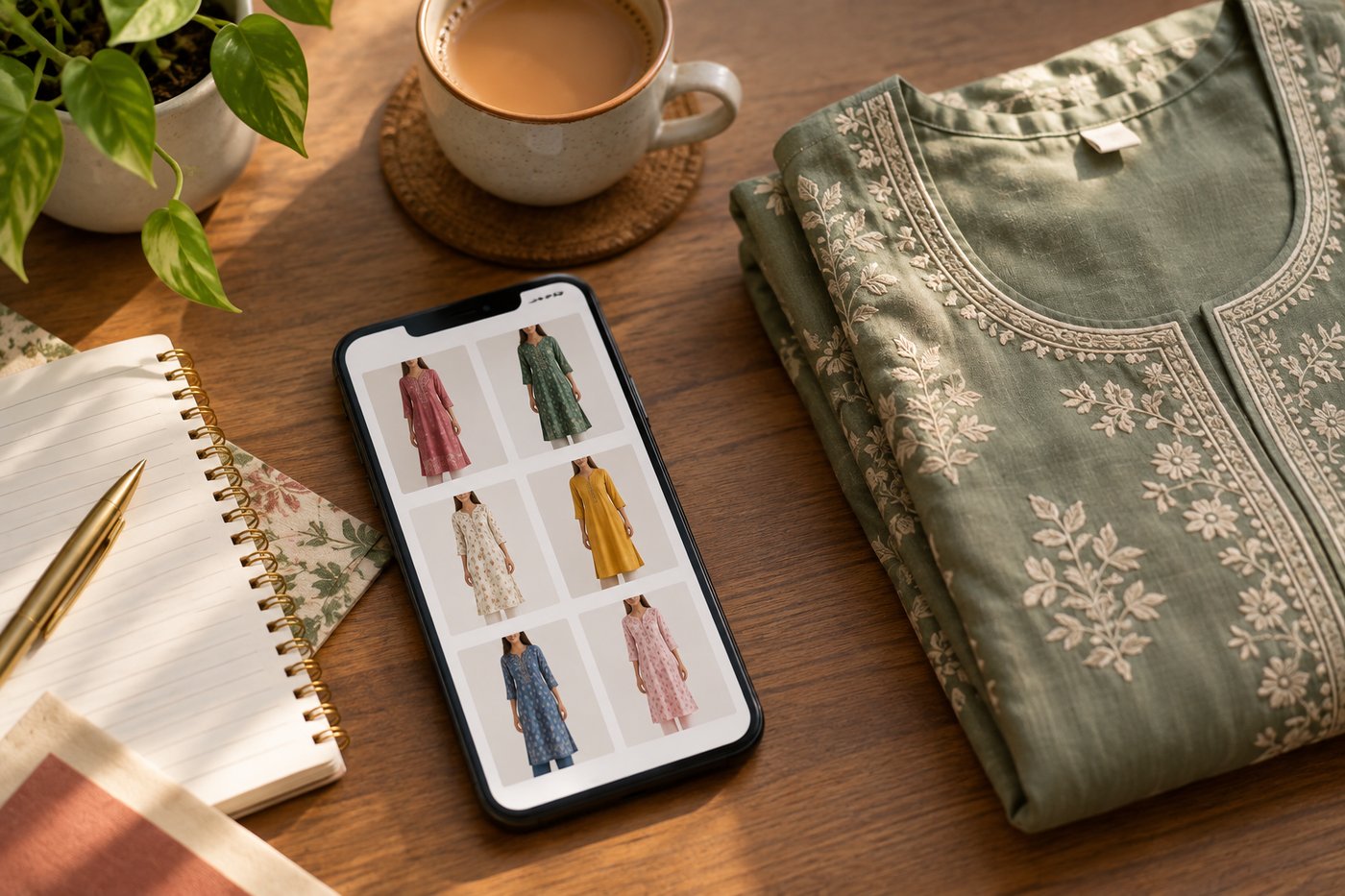
India's online fashion market is projected to cross $35 billion by 2028, and the barrier to entry has never been lower: marketplaces handle logistics and payments, GST registration is free, and AI tools have collapsed the cost of professional product imagery. What used to require a shop, staff, and lakhs of capital can now start from a spare room with 30,000-75,000 rupees.
But low barriers cut both ways — thousands of new sellers join every month, and most stall within their first quarter because they skip fundamentals: they source without a niche, list with phone-quality photos, price without doing fee math, and quit before the marketplace algorithms have data to work with.
This guide is the full sequence, in order: niche and sourcing, legal setup, marketplace selection, photography, listing optimization, pricing, and the first-100-orders plan. Follow it step by step.
Step 1: Pick a Niche Before You Pick Products
"Women's clothing" is not a niche — it's the most competitive battleground in Indian e-commerce. New sellers win by going narrower:
- Category niches: Plus-size kurtis, maternity ethnic wear, boys' festive wear (2-8 years), office-wear cotton sarees, oversized streetwear tees.
- Craft niches: Jaipur block prints, Lucknowi chikankari, Bengal handloom, ajrakh prints — regional crafts have built-in differentiation and story.
- Price-band niches: Premium daily wear (799-1,499) sits in a gap between Meesho's ultra-budget flood and branded pricing.
- Occasion niches: Haldi/mehendi coordinated outfits, airport-look co-ords, Durga Puja collections.
Validation is cheap: search your niche on Amazon, Flipkart, and Meesho. You want to see demand (plenty of reviews on top listings) but visible weakness (mediocre photos, generic listings, obvious sizing complaints in reviews). Demand plus weak execution is your opening. If the top 20 listings all have polished brand imagery and 10,000+ reviews, pick a different lane.
Step 2: Source Your Inventory
India's Wholesale Hubs
| Hub | Known For | Notes |
|---|---|---|
| Surat | Sarees, kurtis, dress materials, lehengas | India's largest synthetic and ethnic wholesale market; very low minimums available |
| Delhi (Gandhi Nagar, Chandni Chowk) | Western wear, denim, kidswear | Asia's biggest readymade garment market; good for trend-led stock |
| Jaipur | Block prints, cotton ethnic, home + apparel crafts | Strong for differentiated, story-driven product |
| Tirupur | T-shirts, knitwear, athleisure | Export-grade quality; ideal for print-on-demand and casualwear brands |
| Ludhiana | Winterwear, woollens, hosiery | Seasonal but high-margin window from September to January |
Can't travel? Use IndiaMART, TradeIndia, or manufacturer WhatsApp groups — but always order paid samples before committing. Check stitching, fabric weight (GSM), color fastness (wash a sample), and measure every size against the vendor's size chart. A vendor whose "L" varies piece to piece will destroy you with returns.
Business Models to Choose From
- Buy wholesale, hold inventory: Best margins (50-70% markup typical), full quality control, but capital locked in stock. The standard path.
- Reselling (Meesho model): List supplier products, supplier ships. Near-zero capital, thin margins, no control over quality or delivery experience.
- Made-to-order with a local tailor/manufacturer: Works for boutique niches; slower fulfillment but zero dead stock.
- Print-on-demand: For t-shirts and casualwear — partner platforms print and ship as orders come in.
Start with 30-50 pieces across 10-15 designs, 2-3 sizes each. Resist the urge to buy deep — your first stock order is market research, and you'll want the remaining capital to double down on whatever actually sells.
Step 3: Legal Setup — GST and Business Basics
- Choose a business structure. Sole proprietorship is fine to start — it's just you plus your PAN. Move to an LLP or private limited company later if you take investment or partners.
- Get GST registration. Free on the government GST portal (gst.gov.in); typically approved in 3-7 working days. You'll need your PAN, Aadhaar, a photo, bank details, and business address proof (a rent agreement or utility bill; home addresses work). Amazon, Flipkart, and Myntra require a GSTIN to onboard. Meesho permits GST-exempt sellers for intra-state sales only — but get the GSTIN anyway; interstate is where the volume lives.
- Open a current account in the business name. Marketplaces settle payments every 7-15 days into this account, and mixing business with personal banking makes GST filing miserable.
- Understand GST on apparel: garments priced below 1,000 attract 5% GST; above 1,000, 12%. Marketplace commissions also carry 18% GST. Budget a CA at roughly 1,000-2,500/month for filing returns once sales start — it's the cheapest stress reduction you'll buy.
- Optional but smart: Register your brand name as a trademark (~4,500 government fee for individuals/small enterprises). It unlocks Amazon Brand Registry later, which protects your listings and unlocks A+ Content.
Step 4: Choose Your Marketplaces
Each platform is a different game. Here's the honest comparison for a new fashion seller:
| Platform | Commission | Audience | Best For | Difficulty |
|---|---|---|---|---|
| Meesho | 0% on most categories (shipping + penalties apply) | Price-first, Tier 2/3 cities, resellers | Unbranded fashion under 700; fastest first orders | Easiest |
| Amazon India | ~17% referral for most fashion + closing/FBA fees | Urban, brand and quality conscious | Branded positioning, 600-2,000 price band, FBA scale | Moderate (gated fashion category) |
| Flipkart | 5-20% by category and price band | Broad, value-driven, strong in ethnic wear | Ethnic wear, festive spikes (Big Billion Days) | Moderate |
| Myntra | Commission negotiated; higher onboarding bar | Fashion-first, brand loyal, higher spend | Established brands with full lookbook imagery | Hardest (selective onboarding) |
The practical playbook: Launch on Meesho plus one of Amazon or Flipkart. Meesho gets you order volume and cash flow fast; Amazon/Flipkart builds the higher-margin, review-backed listings that compound over time. Add Myntra in year two once you have brand imagery and sales history to show. Also list your bestsellers on your own Instagram + WhatsApp catalog from day one — it's free and margin-rich.
Step 5: Product Photography — Your Biggest Lever
On a marketplace, your photo is your shopfront, your salesperson, and your trust signal in one thumbnail. Fashion listings with model shots get 20-30% higher click-through rates than flat-lays, and photography quality is the most visible difference between listings that sell and listings that sit.
Your three options as a new seller:
- Studio photoshoot: 2,000-4,000 per SKU all-in (model, studio, photographer, editing). For 40 SKUs, that's 1-1.5 lakhs — often more than your entire inventory budget. Quality is great; economics are brutal at the start.
- Pure DIY: A phone, window light, and a white backdrop produce workable flat-lays for near zero cost — but no model shots, and hours of background cleanup and resizing per marketplace.
- DIY + AI (the 2026 default for new sellers): Shoot one clean flat-lay of each garment at home, then use an AI try-on tool like CatalogX to generate photorealistic model shots — choosing the model, pose, and background — and export files at exact Amazon, Flipkart, Meesho, and Myntra specifications in one click. At roughly 299 per generation, a 40-SKU catalog gets model imagery for around 12,000 instead of 1.5 lakhs, and new designs go live the same day they arrive from the wholesaler.
Step 6: Write Listings That Rank and Convert
- Title formula: [Brand] + [Product type] + [Fabric/key feature] + [Color] — e.g., "Aarvi Women's Rayon A-Line Kurti with Pockets – Teal". Front-load keywords; mobile search truncates after ~80 characters.
- Cover the buyer's five questions in bullets: fabric and feel, fit and sizing guidance, design details, occasions it suits, and care instructions.
- Include a size chart image with actual garment measurements (chest, waist, length in inches and cm) — not just body sizes. Sizing confusion is the #1 driver of fashion returns in India.
- Use backend keywords for synonyms and spellings buyers actually type: kurti/kurta, palazzo/plazo, chudidar/churidar, "party wear," "office wear."
- Fill every attribute field (sleeve type, neck, pattern, occasion). Marketplace filters run on attributes; empty fields mean invisible listings.
Step 7: Pricing Strategy — Do the Fee Math First
Most new-seller losses come from pricing set before understanding fees. Work backwards from a real example — a kurti you bought at 250 wholesale, listing at 599 on Amazon:
- Referral fee (~17%): −102
- Closing fee: −20
- Shipping/Easy Ship fee: −45 to −65
- GST (18%) on those fees: −30
- Packaging: −15
- Net receipt: ~370-390 → gross profit ~120-140 per unit
Now apply the killer variable: returns. Fashion return rates in India run 15-30%, and on a returned order you lose the two-way shipping and often the packaging. At a 25% return rate, that 130 gross profit per sale drops to roughly 60-70 blended. Price so that your blended margin — after fees AND returns — stays above 25-30%, or ads and one bad month will put you underwater.
- Rule of thumb: price at 2.5-3x your landed product cost on commission marketplaces; 2x can work on Meesho where commission is zero.
- Don't race to the bottom. The cheapest listing attracts the highest-returning buyers. Compete on images, reviews, and sizing accuracy instead.
- Plan for events: Big Billion Days / Great Indian Festival demand discounts — build event headroom into your base price from day one.
Step 8: The First 100 Orders — A Realistic Plan
The first 100 orders are the hardest because you're invisible: no reviews, no sales history, no algorithmic trust. Here's the sequence that works:
- Weeks 1-2 — Launch complete listings. All 10-15 designs live on two marketplaces, every listing with 5+ images including a model-shot main image, full attributes, and a size chart. Incomplete listings never recover algorithmically; fix them before, not after.
- Weeks 1-4 — Run small, targeted ads. 200-500/day on Amazon Sponsored Products or Flipkart PLA on your 3-4 strongest designs. The goal is not profitable ads yet — it's forcing early impressions and sales data so the algorithm learns your listings. Kill keywords with clicks but no orders weekly.
- Every day — Process orders fast. Ship same-day or next-day without fail. Early account health metrics (cancellation rate, late dispatch) shape how much visibility the platform gives you for months.
- Weeks 2-6 — Work your first-degree network. Share your listings (not just Instagram posts — actual marketplace links) in family and community WhatsApp groups. Early full-price orders from real buyers generate the verified reviews that unlock stranger traffic. Never buy fake reviews; platforms detect them and the penalty is delisting.
- Weeks 4-8 — Double down on winners. By now 2-3 designs will show disproportionate traction. Reorder them deep, shoot/generate more image variations for them, raise ads on them, and cut the losers without sentiment.
- Weeks 6-10 — Add the flywheel pieces. Enroll winning SKUs in FBA/Flipkart Advantage for the fulfillment badge, ask happy buyers (via the platform's official tools) for reviews, and expand winning designs into new colorways — each colorway is a cheap new listing with proven demand.
With this cadence, most sellers cross 100 orders in 4-10 weeks. If you're stuck at week 6 with near-zero orders, the problem is almost always one of three things, in this order: main image quality, price vs. comparable listings, or a niche with no real demand. Diagnose in that order.
Step 9: Handle Returns and Operations Like a Professional
Operations rarely make it into "start a business" guides, but they decide whether month three is growth or firefighting:
- Open every return. Fashion returns in India include a meaningful share of fraud — worn garments, swapped products, empty packets. Video-record your unpacking of returned parcels; marketplaces accept this evidence for claims, and sellers who file claims recover real money.
- Track return reasons per SKU. "Size issue" means fix your size chart. "Color different" means fix your photos or editing. "Quality" means fix your vendor. The return report is your cheapest consultant.
- Standardize packaging early. A flat rate poly-mailer with a thank-you card costs 8-15 per order and measurably improves review sentiment. Buy packaging in bulk from the same wholesale hubs you source garments from.
- Reconcile payments monthly. Marketplace settlement reports contain errors — missed reimbursements for lost returns, wrong fee tiers. An hour a month of reconciliation typically recovers more than it costs.
- Watch your account health dashboard weekly. Late dispatch and cancellation metrics compound silently until the platform suppresses you. Treat them like a credit score.
Step 10: Build Your Own Channel Alongside Marketplaces
Marketplaces bring demand but own the customer. From month one, run a parallel owned channel — not as a replacement, but as margin insurance:
- Instagram as your lookbook: Post your best model shots consistently. Since AI-generated imagery gives you studio-grade photos anyway, the same assets feed your grid, stories, and ads at no extra cost.
- WhatsApp Business for repeat buyers: A printed card in every parcel ("Follow us for new drops / order direct for 10% off") converts marketplace buyers into direct customers where you keep the full margin.
- A simple storefront later: Shopify, Dukaan, or Instamojo when direct demand justifies it — usually after 500+ marketplace orders, not before. Premature website-building is one of the most common time sinks for new sellers.
Common First-Year Mistakes to Avoid
- Buying too much stock upfront. Your first order is research. Buy shallow, learn, reorder deep.
- Launching with bad photos "for now". The algorithm forms its opinion of your listing in the first weeks. There is no "later."
- Ignoring returns math. Track your return rate per SKU from order one; a 35%-return design is a loss-maker at any price.
- Spreading across 5 platforms at once. Two done well beats five done badly. Each platform has its own operational rhythm to learn.
- Skipping GST compliance. Mismatched filings freeze marketplace payments. Pay the CA.
- Quitting at week 5. Marketplace flywheels are slow to start and then compound. The sellers who win are usually just the ones still shipping in month four.
A Realistic 90-Day Timeline
Pulling the ten steps into a calendar you can actually follow:
- Days 1-15: Niche research and validation; apply for GST; open the current account; order samples from 3-4 vendors.
- Days 15-30: Evaluate samples, place the first stock order (30-50 pieces); register seller accounts on Meesho and Amazon/Flipkart; start the fashion category approval process where required.
- Days 30-40: Stock arrives — quality-check and measure every design; shoot flat-lays at home; generate AI model shots and marketplace exports; write listings with size charts and full attributes.
- Days 40-70: Listings live; ads running at 200-500/day on top designs; ship every order same/next day; push listings through your personal network for first reviews.
- Days 70-90: Read the data — reorder winners deep, cut losers, add colorways of proven designs, move top SKUs to FBA/fulfillment programs, and start your parallel Instagram/WhatsApp channel in earnest.
By day 90 a well-executed launch typically sits at 100-300 cumulative orders, a clear picture of which 20% of designs will drive 80% of revenue, and — most valuably — an operating rhythm. That rhythm, not any single tactic, is the actual business.
Your Launch Checklist
- Niche validated: demand visible, execution gap visible
- 30-50 pieces sourced with samples checked for quality and sizing
- GSTIN approved, current account open, CA lined up
- Seller accounts live on Meesho + Amazon or Flipkart
- Every SKU: flat-lay shot at home, AI model shots generated, marketplace-spec exports done
- Listings complete: keyword titles, 5 bullets, size chart image, all attributes
- Prices set with fee + return math at 25-30% blended margin
- 200-500/day ad budget ready for weeks 1-4
Starting an online clothing business in India in 2026 isn't about one big move — it's about doing eight unglamorous steps in the right order, then staying in the game long enough for the flywheel to spin. Everything on this list is doable from home, this month.
Related Articles
- How to Sell Fashion on Amazon India: Complete Seller Guide 2026
- How to Sell Fashion on Meesho: Complete Seller Guide 2026
- AI Try-On vs Studio Photoshoot: Cost Breakdown for Indian Fashion Sellers (2026)
Frequently Asked Questions
A lean start costs 30,000-75,000 rupees: 20,000-50,000 for initial inventory (30-50 pieces), around 2,000-3,000 for GST registration help if you use a professional, under 3,000 for a home photography setup or AI-generated product images, and a small buffer for packaging and initial ads. Reselling models on Meesho can start with even less since some suppliers offer low minimum orders.
Yes, for most marketplaces. Amazon, Flipkart, and Myntra require a GSTIN to register as a seller. Meesho allows sellers without GST to sell within their own state under the composition-exempt category, but a GSTIN is required for interstate sales and unlocks the full marketplace. Getting GST registration is free on the government portal and typically takes 3-7 working days.
Meesho is the easiest entry point — zero commission on most categories, simple onboarding, and a price-focused audience ideal for unbranded fashion. Amazon and Flipkart suit sellers with GST, better margins, and quality imagery. Myntra is invite-heavy and brand-focused, best attempted after you have traction elsewhere. Most successful sellers start on Meesho plus Amazon or Flipkart, then expand.
The main wholesale hubs are Surat for sarees, kurtis, and dress materials; Delhi (Gandhi Nagar, Chandni Chowk) for western wear and denim; Jaipur for block prints and ethnic wear; Ludhiana for winterwear; and Tirupur for t-shirts and knitwear. You can also source via B2B platforms like IndiaMART and TradeIndia, or start with local manufacturers who offer low minimum order quantities.
Photograph each garment as a simple flat-lay at home with good lighting, then use an AI virtual try-on tool like CatalogX to generate photorealistic model shots. The tool outputs images at exact marketplace specifications for Amazon, Flipkart, Meesho, and Myntra at a fraction of studio photoshoot costs, letting new sellers launch with professional-looking listings from day one.
With 30-50 well-photographed SKUs listed on two marketplaces, competitive pricing, and small daily ad budgets, most new fashion sellers reach 100 orders within 4-10 weeks. The biggest accelerators are model-shot main images, fast order processing that builds account health, and doubling down on whichever 2-3 designs get early traction.