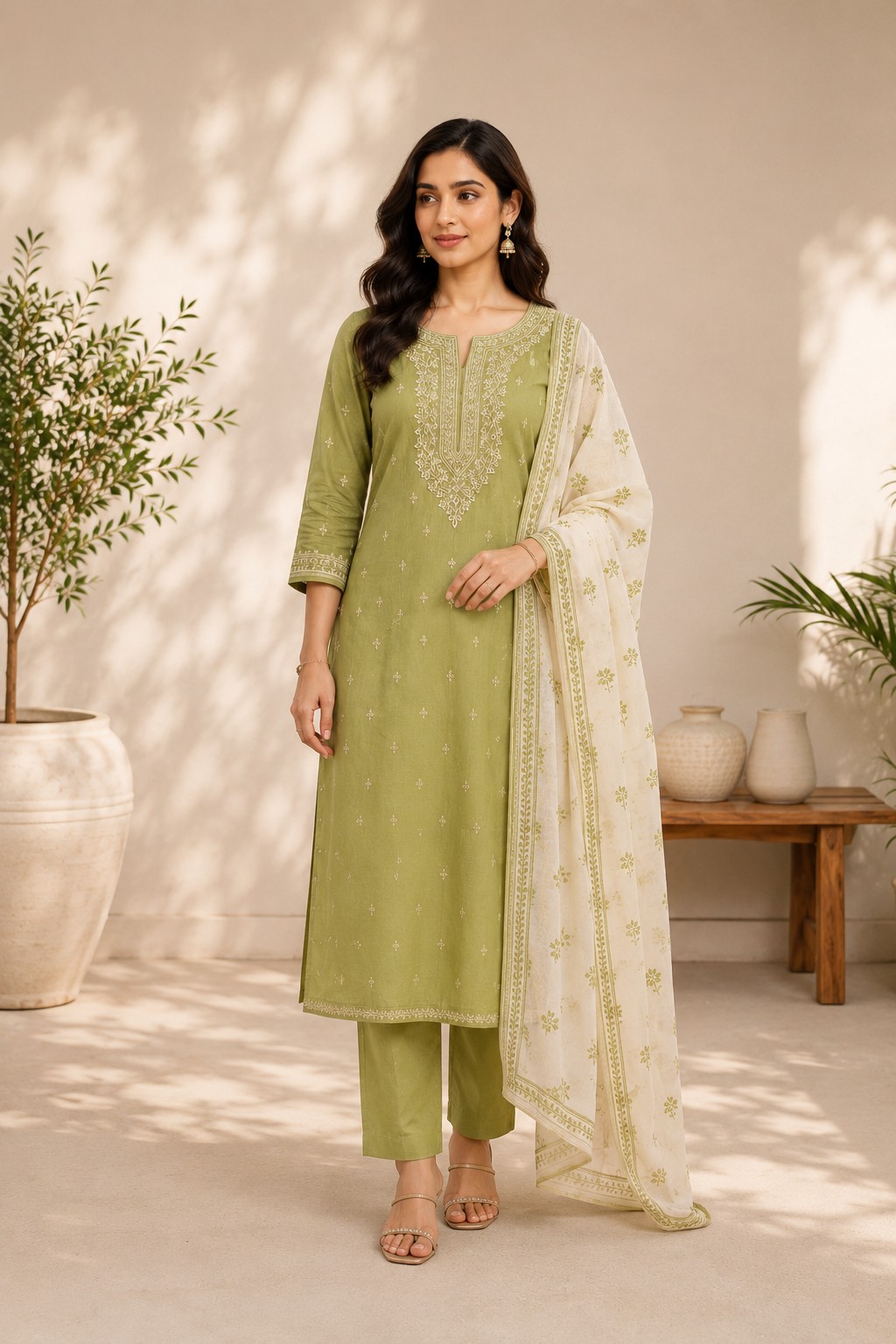
Every returned parcel costs an Indian fashion seller twice: the forward and reverse shipping you often absorb, and the garment that comes back creased, tried-on, or unsellable. And the single biggest driver of those parcels is not fraud or fickle buyers — it is expectation mismatch. The buyer pictured one thing from your listing and unboxed another. Your product photos are where that picture forms, which makes them the highest-leverage, lowest-cost place to work on returns. This guide covers why fashion returns actually happen, the photo practices that set accurate expectations, and an honest answer to a question sellers increasingly ask: do AI images make returns better or worse?
Why Fashion Returns Actually Happen
Apparel is the hardest category to buy sight unseen because three things cannot be touched through a screen — and each becomes a return reason when the listing fails to communicate it:
- Fit and length. A buyer cannot tell from a flat-lay whether a kurti is a relaxed A-line or a slim straight cut, where the hem falls, or how much ease the sleeves have. If she guesses wrong, the parcel comes back — even when the size chart was technically correct, because most buyers judge fit from the photo, not the chart.
- Colour. Over-brightened studio edits, warm indoor lighting, and heavy saturation all shift how a fabric photographs. "Colour different from image" is one of the most persistent complaints in fashion e-commerce, and it is almost always the photo's fault, not the buyer's.
- Fabric and drape. A photo that hides how the material falls — stiff cotton vs fluid rayon vs clingy lycra — leaves the buyer to imagine it. The unboxing then delivers a surprise, and surprises get returned.
Layer on Indian market realities — heavy cash-on-delivery usage that makes refusing a parcel easy, and generous marketplace return policies — and the pattern is clear: anything your listing leaves ambiguous, the buyer fills in optimistically, and optimism unravels at the doorstep. The job of your product photos is to leave as little to imagination as possible.
5 Photo Practices That Set Accurate Expectations
1. Get colour right, then leave it alone
Shoot in neutral daylight, avoid yellow indoor bulbs, and resist the urge to push saturation to make the garment "pop". Before uploading, hold the physical garment next to the image on your screen — ideally on two different screens — and correct until they match. A slightly less dramatic photo that matches the delivered item beats a stunning photo that triggers a "colour different" return.
2. Show multiple angles and honest close-ups
Front, back, and side views answer fit questions; close-ups of the weave, print, embroidery, and stitching answer fabric questions. Include the details a buyer would inspect in a shop — neckline finishing, button quality, lining. Every question a photo answers is a question the doorstep does not.
3. Include on-model shots for fit context
This is the single biggest expectation-closer in apparel. A model shot shows length, drape, and silhouette in a way no flat-lay can — where the kurti hem actually falls, how the saree pallu drapes, whether the fit is boxy or tailored. Buyers translate "on her, it looks like this" into "on me, it will look roughly like that", and that translation is what prevents fit-surprise returns.
4. Show the garment on more than one body type
A garment photographed only on one slim model gives a size-M buyer very little to go on — and gives an XL or XXL buyer nothing at all. Showing the same garment on different body types, including plus-size models, lets more of your actual buyers picture the item on themselves accurately. Size confusion is a core return driver, and body-type variety is photographic size context.
5. Style honestly
If the dupatta, belt, or jewellery in the photo is not included, either remove it or state clearly what ships. Aspirational styling that implies a fuller package than the buyer receives is a self-inflicted "item not as described" return.
| Expectation gap | Photo practice that closes it |
|---|---|
| Colour surprise | Daylight shooting, no over-saturation, verify against the physical garment |
| Fit / length surprise | On-model shots showing silhouette, hem position, and drape |
| Size confusion | Models across body types + a real measurement-based size chart |
| Fabric surprise | Close-ups of texture and weave; drape visible on a body |
| "Not as described" | Honest styling; show exactly what ships |
The AI Question: Where It Helps, Where It Hurts
You may have read claims that AI images increase returns. There is a real point buried in that claim, and it deserves an honest treatment rather than a defensive one — because whether AI helps or hurts your return rate depends entirely on what the AI generated.
Where the criticism is right: fully AI-generated product images
If the garment in your listing was invented by a text-to-image tool — a "beautiful red banarasi saree" conjured from a prompt — then the buyer is ordering a product that does not exist. The delivered saree will have a different weave, border, and sheen than the invented one, because no physical garment matches an AI's imagination. That is expectation mismatch manufactured at the source, and it is fair to say this kind of imagery does drive returns. It is also why marketplaces treat fabricated product imagery as a policy violation — we cover the platform rules in detail in our AI image policy guide. If a tool invents your product, do not use it for listings. On this point, the sceptics are correct.
Where the criticism misses: real-garment virtual try-on
But "AI images" is not one thing. Real-garment virtual try-on works in the opposite direction: it starts from a photograph of your actual garment — flat-lay, hanger, or mannequin shot — and drapes that garment onto a model. The print, border, and construction in the output come from your photo, not a prompt. The product shown is the product shipped; what the AI adds is the model and setting.
Look at what that does to the expectation gaps above: the garment's true appearance is preserved (colour and pattern accuracy), while the image gains exactly the context flat-lays lack — how the garment sits on a body. In other words, used correctly, this category of AI imagery adds the return-reducing information (fit context, drape, body-type variety) without introducing the return-causing one (a fake product). For sellers who cannot afford model photoshoots for every SKU, it makes the single most effective photo practice — on-model shots — accessible at catalog scale: 40+ Indian models, 50+ backgrounds, about 30 seconds per image.
Your responsibilities when using AI model imagery
- Verify every output against the physical garment. If any visible detail drifted — print repeat, border, neckline — regenerate or discard. You are the final quality gate.
- Keep at least one plain, real photo in every listing. It anchors buyer trust and gives an unambiguous accuracy reference.
- Never imply a human model wore the item, and check each marketplace's current disclosure guidelines, which continue to evolve as of July 2026 — verify in your seller panel.
Beyond Photos: The Rest of the Return Equation
Photos are the highest-leverage fix, but they are not the whole story. To be straight with you about what images cannot do:
- Size charts still matter. Publish real garment measurements — chest, length, sleeve — not just S/M/L labels. Photos give intuition; charts give certainty.
- Fabric descriptions matter. One precise sentence — "lightweight rayon with a soft fall, semi-sheer" — prevents the surprise no photo fully conveys.
- Quality and packing matter. If the stitching disappoints or the parcel arrives crushed, no image was going to save that order.
Better photos can help reduce returns by closing the expectation gap — that is the honest claim. They cannot eliminate returns, and any tool promising a specific percentage drop is guessing on your behalf.
A Practical Workflow for Sellers
- Shoot each SKU once, properly: daylight, steady phone, true colours — front, back, and a fabric close-up.
- Verify colour against the physical garment before any editing.
- Generate on-model context: upload the real garment photo to CatalogX and create model shots — including on plus-size models — in about 30 seconds each. Check every output against the garment.
- Assemble the listing: model shot for fit context, plain real photo for trust, close-up for fabric, back view for completeness.
- Pair with a measurement-based size chart and one honest fabric sentence.
- Watch your return reasons in your seller panel monthly — if "colour different" or "size issue" dominates, you now know which photo practice to fix first.
Getting started costs nothing: CatalogX gives 5 free credits on signup with no card, the Starter pack is ₹299/month for 15 HD credits, and Pro at ₹849/month covers 50 generations — a fraction of a single model photoshoot day.
Your real garment, shown on 40+ Indian models — accurate product, added context, ~30 seconds per image.
Start Free — 5 Credits →
Frequently Asked Questions
The dominant cause is expectation mismatch: the delivered garment differs from what the buyer pictured. That gap shows up as fit surprises (no sense of how the garment sits on a body), colour surprises (over-edited or badly lit photos), and fabric surprises (no drape or texture cues in the images, vague descriptions). Cash-on-delivery habits and easy return policies amplify the effect, but the root is almost always information the product page failed to convey.
It depends entirely on what the AI generated. Fully AI-generated product images — where the garment itself is invented from a text prompt — do widen the expectation gap, because the buyer orders something that does not exist, and disappointment on delivery is built in. Real-garment virtual try-on is the opposite workflow: it starts from a photograph of your actual garment and shows that garment on a model, adding fit context without changing the product. The question to ask of any image is not whether AI touched it but whether the garment shown is the garment shipped.
The practices that close the biggest expectation gaps: accurate, un-oversaturated colour verified against the physical garment; multiple angles including front, back, and close-ups of fabric and detailing; at least one on-model image so buyers can judge length, fit, and drape; models across body types so buyers can picture the garment on themselves; and honest styling that does not show accessories or fits the buyer will not receive. Pair these with a real measurement-based size chart.
A flat-lay tells buyers what a garment looks like; a model shot tells them how it wears — where a kurti's hem falls, how a saree drapes, whether a fit is loose or tailored. Fit and length surprises are among the most common return reasons in apparel, and on-model images give buyers the information to self-select the right size and style before ordering. Showing the garment on more than one body type extends that benefit to more of your buyers.
CatalogX can help with the image-side causes of returns: real-garment virtual try-on shows your actual product on a model in about 30 seconds, adding the fit and drape context that flat-lays lack, with 40+ Indian models including plus-size options so buyers see the garment on a relatable body type. Because the output garment comes from your uploaded photo rather than a text prompt, the accuracy that prevents mismatch is preserved. No tool can promise a specific reduction — returns also depend on sizing, quality, and fulfilment — but accurate, context-rich images address the expectation gap directly.