Amazon T-Shirt Image Requirements
Selling t-shirts and graphic tees to US apparel shoppers who filter hard on image quality? Here is what Amazon expects from your t-shirt images in 2026:
| Requirement | Amazon specification |
|---|
| MAIN image | Adult apparel MUST be shown on a standing human model — no mannequins, no flat-lays, no hangers |
| Background | Pure white, RGB 255,255,255 — off-white gets flagged |
| Frame fill | Product fills roughly 85% of the frame |
| Resolution | 1600px+ on the longest side to enable zoom (2000px recommended) |
| Extras | No text, logos or watermarks on the MAIN image |
The rule that matters most: for adult apparel, the Amazon MAIN image must show the garment on a standing human model — mannequins, flat-lays and hanger shots are not accepted in the MAIN slot. Every photo CatalogX generates for Amazon starts from that requirement.
How to Shoot T-Shirts for Amazon
Amazon US treats adult apparel MAIN images strictly: the t-shirt must be on a standing human model, on pure white (RGB 255,255,255), filling about 85% of the frame. A flat-lay or mannequin shot in the MAIN slot for adult clothing risks suppression — and for t-shirt sellers running many SKUs, shooting every colorway on a model is exactly the cost that never pencils out.
CatalogX generates the standing-model white-background MAIN shot from one flat photo per design, with the print reproduced exactly. Then use secondary slots for what MAIN can't show: a print close-up, a back view, and a lifestyle scene. Same model across every colorway keeps the listing grid coherent.
One Flat Photo In, One Listing Shot Out
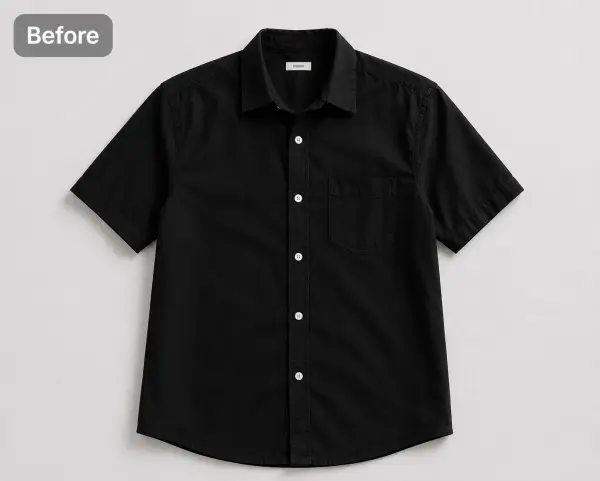 Before — flat photo
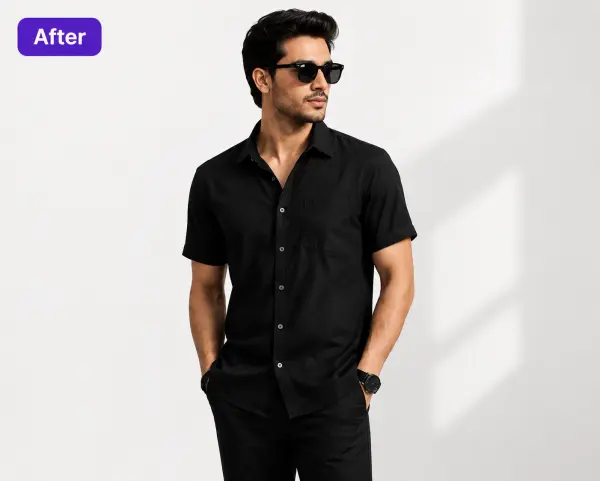 After — CatalogX
A black shirt from our public gallery, 30 seconds apart — the print-and-fabric flow is identical for t-shirts: what your flat photo shows is what lands on the model.
From Photo to Live Listing
1. Upload your t-shirt — a flat-lay, hanger shot or supplier photo works. Tags and pins are removed automatically.
2. Pick a model — 40+ models across skin tones and body types. The AI respects your garment's construction; it doesn't guess.
3. Set the scene — pure white for the compliant MAIN image, lifestyle scenes for secondary slots.
4. Generate and export — about 30 seconds per image, sized for Amazon's specs. You own every output; commercial use is included on all plans, no watermarks.
On cost: a US studio photoshoot runs $300+ per session, or $50–150 per finished image. CatalogX starts free (5 credits, no card) and paid plans start at $9.99/month — see USD pricing or the full AI vs studio cost breakdown.