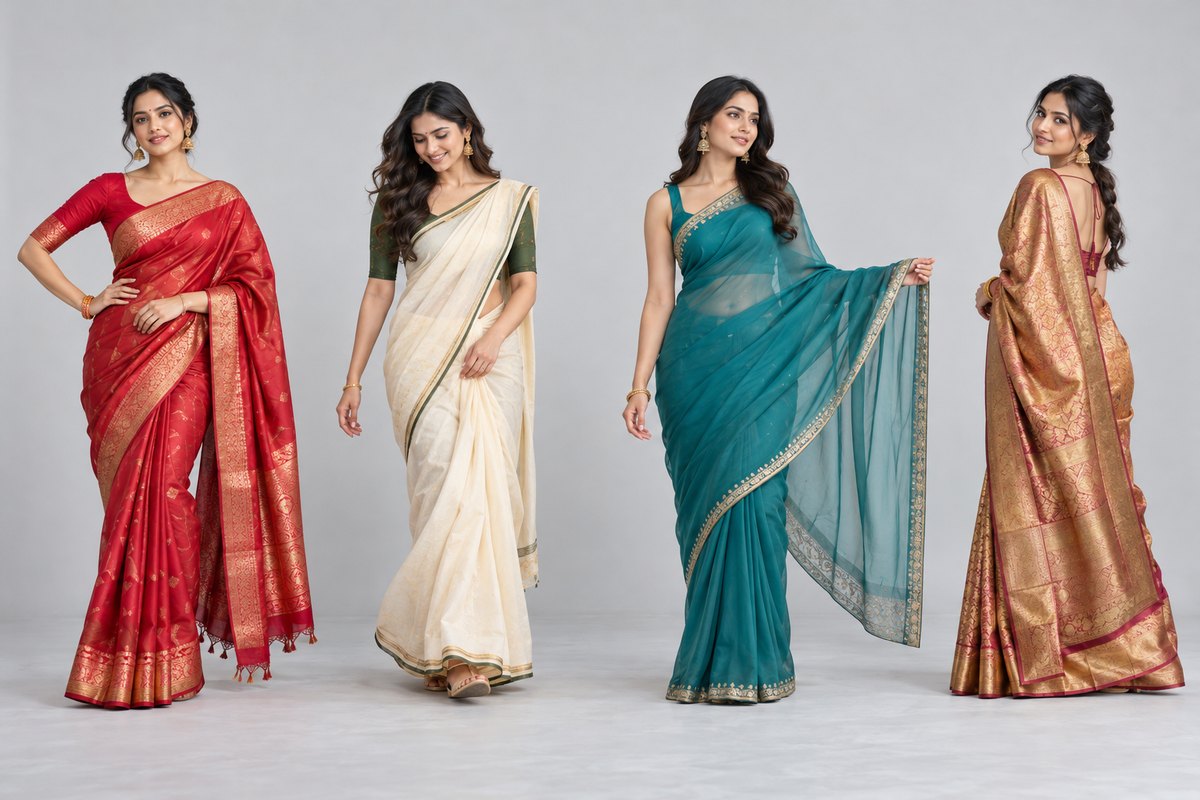
A saree is the hardest garment in Indian fashion to photograph well. Unlike a kurti or a t-shirt, a saree has no fixed shape — its entire appeal lies in how it drapes, how the pleats fall, how the pallu flows, and how the border frames the body. Two photos of the same saree can look like two completely different products depending on the pose.
That's why pose selection matters more for sarees than for any other category. The right pose shows the drape, the border, the blouse, and the fabric behavior all at once. The wrong pose hides the border, bunches the pleats, and makes a 4,000-rupee Kanjivaram look like a 400-rupee synthetic.
This guide breaks down every pose category that works for saree e-commerce — standing, walking, sitting, pallu-focused, and close-up — with specific direction notes you can hand to a photographer or replicate with AI-generated model shots. It's written for Indian sellers listing on Amazon, Flipkart, Meesho, Myntra, and their own D2C stores.
Why Poses Make or Break Saree Listings
Before the pose-by-pose breakdown, understand what a saree shopper is actually evaluating when she scrolls past your listing:
- The drape: Does the fabric fall gracefully or stiffly? Silk, georgette, chiffon, cotton, and organza all drape differently, and buyers can tell from a single photo.
- The border and pallu: For most traditional sarees, the border and pallu carry the design value. If your pose hides them, you've hidden the reason to buy.
- The blouse pairing: Shoppers want to see how the blouse looks with the saree — neckline, sleeve length, and contrast.
- Body realism: Buyers mentally project themselves into the photo. A natural, relatable pose converts better than an overly editorial one.
Marketplace data backs this up: fashion listings with model-on shots get 20-30% higher click-through rates than flat-lays, and for sarees specifically the gap is even wider because a folded saree on a white background communicates almost nothing about the drape.
Standing Poses: The Backbone of Every Saree Catalog
Standing poses do the heavy lifting in a saree catalog. Your main image will almost always be a standing pose, so get these right first.
1. The Classic Front-Facing Pose
The model stands straight, facing the camera, weight evenly distributed, pallu draped over the left shoulder in the standard Nivi style, one arm relaxed at the side and the other gently holding the pallu edge.
- What it shows: Full drape from shoulder to hem, pleat placement, blouse front, and the border running down the body.
- Best for: Main catalog image on every marketplace. It meets the 85% frame-fill rule on Amazon and Flipkart and reads clearly even at thumbnail size.
- Direction note: Keep the chin level and shoulders relaxed. Ask the model to pull the pallu slightly away from the body so the border pattern is visible rather than folded into shadow.
2. The Three-Quarter Turn
The model rotates 30-45 degrees away from the camera with her face turned back toward the lens. This is the single most flattering standing pose for sarees.
- What it shows: The pleats in profile, the way the fabric wraps the waist, and a partial view of the pallu falling behind.
- Best for: Image 2 or 3 in your set. Also the strongest pose for heavier silks like Kanjivaram and Banarasi, because the side angle catches the zari shimmer.
- Direction note: The hand nearer the camera should rest lightly on the pleats — it draws the eye to the workmanship at the waist.
3. The Back Pose with Pallu Spread
The model faces away from the camera and holds the pallu open across her back with one or both hands, spreading the fabric like a fan.
- What it shows: The full pallu design — often the most elaborate part of a saree — plus the blouse back, which many buyers specifically check.
- Best for: Sarees where the pallu carries the hero motif: Banarasi brocades, kalamkari prints, heavily embroidered georgettes.
- Direction note: Spread the pallu flat enough that the motif reads clearly, but keep some natural fold so the fabric doesn't look like a bedsheet.
4. The Leaning Pose
The model leans lightly against a wall or pillar at a slight angle, one foot crossed in front of the other. This adds editorial polish for D2C and Instagram catalogs.
- What it shows: A relaxed, lifestyle mood that helps buyers imagine wearing the saree at an event rather than in a studio.
- Best for: Lifestyle images in positions 4-7, your website's lookbook, and social ads. Not for marketplace main images, which need clean backgrounds.
Walking Poses: Showing Fabric in Motion
Nothing communicates fabric quality like movement. A walking pose shows whether a georgette flows, whether a silk holds structure, and whether an organza has that coveted airy lift.
5. The Mid-Stride Walk
The model walks toward the camera and the shot is captured mid-stride, front foot forward, pallu trailing slightly.
- What it shows: The natural flow of the lower drape and the movement of the pleats — the exact thing a buyer can't judge from a static shot.
- Best for: Lightweight fabrics: chiffon, georgette, crepe, and lightweight cottons. These fabrics look their best in motion.
- Direction note: Shoot in burst mode and pick the frame where the front foot has just landed — that's when the fabric shape is most graceful.
6. The Turning Walk (Pallu Flare)
The model takes a step and turns, letting the pallu flare outward with momentum. This is the "hero shot" pose used by premium saree brands.
- What it shows: Maximum fabric drama. The pallu opens up mid-air, showing both the design and the fabric's weight in one frame.
- Best for: Banner images, ad creatives, festive and wedding collections.
- Direction note: This pose takes multiple attempts with a live model. With AI generation, you can select a flare pose directly and skip the twenty retakes.
Sitting Poses: Trust-Builders That Reduce Returns
Seated poses rarely work as main images, but they earn their place in positions 4-6 of your image set. Here's why: a large share of saree returns happen because the saree "looked different in real life." A seated pose shows how the fabric actually behaves — whether pleats crumple, whether the fabric creases sharply, how the pallu pools.
7. The Floor-Seated Pose
The model sits gracefully on the floor with the saree spread around her, pallu arranged over the shoulder or across the lap.
- What it shows: The saree's spread and the design across a large visible area of fabric. Especially strong for printed sarees where the overall pattern is the selling point.
- Best for: Festive collections, silk sarees, and lookbook imagery.
8. The Chair-Seated Pose
The model sits on a chair or stool, upright posture, hands resting on the lap or holding the pallu edge.
- What it shows: A realistic everyday view — this is how the saree will look at the office, at a function, at dinner. It quietly answers the buyer's question, "Will this stay manageable when I sit?"
- Best for: Office-wear cottons, linen sarees, and daily-wear synthetics.
Pallu Draping Styles to Photograph
The same saree can be photographed in multiple draping styles, and the style you choose should match your target buyer. The main options:
| Draping Style | Description | When to Use |
|---|---|---|
| Nivi (open pallu) | Pallu over the left shoulder, falling loose behind | Default for all catalogs — the most widely worn style across India |
| Nivi (pinned pallu) | Pallu pleated and pinned at the shoulder | Office-wear sarees; shows the border in a neat vertical line |
| Seedha pallu (Gujarati) | Pallu brought over the right shoulder to the front | Bandhani, gharchola, and sarees targeting Gujarat/Rajasthan buyers |
| Bengali drape | Wide pleatless drape with the pallu wrapped around | Tant, jamdani, and Durga Puja collections |
| Lehenga-style drape | Pre-pleated circular drape resembling a lehenga | Party-wear and pre-stitched sarees targeting younger buyers |
For most listings, shoot the Nivi drape as your primary set and add one regional or fashion drape as a supporting image if it matches your audience. Don't mix drape styles across your main images — it confuses shoppers comparing listings side by side.
Close-Up Angles That Sell the Craftsmanship
Full-body poses sell the look; close-ups sell the price. If you're charging a premium for zari work, handloom weave, or embroidery, you must prove it with detail shots:
- Border close-up: A 45-degree angled shot of the border along the pleats or hem. Fill the frame so the weave or embroidery detail is unmistakable.
- Pallu motif close-up: Shot flat or over the model's shoulder, showing the densest section of the pallu design.
- Fabric texture shot: A tight macro-style shot showing the weave. Crucial for handlooms — buyers paying handloom prices want proof of handloom texture.
- Blouse detail: Neckline and sleeve shots if the blouse piece has matching work.
- Waist/pleat detail: Shows how the pleats sit — a subtle quality signal for stitched-fall and pre-pleated sarees.
Cultural Context: Getting the Details Right
Saree buyers notice cultural details that generic photography guides miss. A few rules Indian sellers should follow:
- Match the styling to the saree's identity. A Kanjivaram styled with a messy bun and sneakers reads as fashion-editorial; the same saree with a neat bun, jhumkas, and a bindi reads as authentic festive wear. Know which market you're selling to.
- Respect regional draping conventions. If you sell a Madisar or a Nauvari saree with a standard Nivi drape, buyers from those communities will notice — and may distrust the listing.
- Keep jewellery proportional to the price point. Heavy temple jewellery on a 600-rupee daily-wear cotton creates a mismatch that raises return rates. Light studs and a thin chain suit everyday sarees.
- Show realistic body diversity. Indian shoppers increasingly respond to models who look like them. If your buyers are 30-50 year old women buying office cottons, a relatable model outperforms a runway look.
Pose Selection by Saree Type
| Saree Type | Priority Poses | Why |
|---|---|---|
| Kanjivaram / Banarasi silk | Front-facing, three-quarter, back pallu spread | Static poses catch zari shimmer; the pallu carries the hero motif |
| Georgette / chiffon | Walking, turning flare, three-quarter | Lightweight fabrics sell on flow and movement |
| Cotton / linen daily wear | Front-facing, chair-seated, pinned pallu | Buyers want practicality and a neat office-ready look |
| Printed synthetics | Front-facing, floor-seated spread | The overall print pattern is the selling point |
| Pre-stitched / party sarees | Lehenga-drape standing, leaning, walking | Younger buyers respond to fashion-forward styling |
Getting 40+ Saree Poses Without a Photoshoot
Here's the practical problem: a professional saree shoot covering even 6 poses per SKU costs 2,000-4,000 rupees per saree once you account for the model, studio, draping assistant (sarees need one), and post-production. For a catalog of 50 sarees, that's 1-2 lakhs and several days of shooting — and every new design repeats the cost.
This is exactly the workflow CatalogX was built to replace. Instead of booking a shoot:
- Upload a photo of your saree — a flat-lay, a mannequin drape, or even a supplier image.
- Choose from 40+ model poses for sarees — including front-facing, three-quarter, back pallu-spread, walking, flare, seated, and close-up compositions, across multiple drape styles and model looks.
- Generate photorealistic model shots in seconds. The AI handles the pleats, pallu fall, and fabric behavior realistically — the details that make or break saree imagery.
- Export marketplace-ready files at the exact sizes Amazon, Flipkart, Meesho, and Myntra require, with compliant backgrounds.
Because each pose is a generation rather than a retake, you can build the full 6-image pose sequence for a saree in minutes at roughly 299 per generation — and A/B test different poses for the main image without ever re-booking a studio. Sellers routinely find that switching the main image from a flat-lay to a front-facing model pose lifts click-through rates by double digits.
Common Saree Pose Mistakes to Avoid
- Hiding the border in shadow. A pallu folded flat against the body buries the border — the most valuable design element. Always pull the pallu slightly away from the torso or spread it.
- Shooting every saree in the same single pose. A georgette shot like a Kanjivaram wastes its flow; a Kanjivaram shot mid-twirl loses its structure. Match pose to fabric.
- Camera too high or too low. Shooting from above forehead height shortens the drape and distorts proportions. Keep the lens at the model's chest height for standing poses.
- Over-editorial posing for daily-wear sarees. Dramatic fashion poses on a 700-rupee office cotton create a disconnect that suppresses conversion. Relatable poses sell relatable sarees.
- Cluttered hands. Both hands doing something — holding the pallu, on the hip, touching the hair — looks busy. One active hand, one relaxed hand is the classic rule.
Quick Checklist Before You Publish
- Main image: front-facing standing pose, product filling 85% of the frame, marketplace-compliant background.
- At least one pose showing the pallu design fully (back spread or over-shoulder).
- At least one close-up of the border or work.
- Drape style matches the saree's regional identity.
- Consistent model, lighting, and styling across all images of the same SKU.
- All images at 2000 x 2000 px or higher so zoom works.
Get the poses right and everything downstream — click-through rate, conversion, and returns — improves. Whether you shoot with a photographer or generate with AI, use this guide as your pose brief.
Related Articles
- AI Saree Draping: How Virtual Try-On Handles Pleats, Pallu & Fabric (2026)
- How to Photograph Sarees & Kurtas for E-Commerce Without a Model
- Choosing the Right Pose, Angle & Background for Your Product Photos
- Model Pose Reference Guide: Which Pose to Use for Catalog Photos
Frequently Asked Questions
The straight front-facing standing pose with the pallu draped over the left shoulder works best for main catalog images. It shows the full drape, border, and blouse in one frame, meets the 85% frame-fill requirement on Amazon and Flipkart, and gives shoppers an honest view of how the saree falls on the body.
A high-converting saree listing needs 5-7 images: a front-facing standing pose for the main image, a three-quarter or side pose showing the pleats, a back pose showing the pallu spread, one close-up of the border or embroidery, one fabric texture shot, and optionally a seated or walking pose for lifestyle context.
Yes. AI virtual try-on tools like CatalogX let you upload a flat-lay or mannequin photo of your saree and generate photorealistic model shots. CatalogX offers 40+ model poses for sarees, including standing, walking, seated, and pallu-focused poses, so you can build a complete image set for each SKU without a photoshoot.
Photograph the style your target buyer actually wears. The Nivi drape with the pallu over the left shoulder is the default for most catalogs because it is the most widely worn style across India. For regional sarees like Bengali tant or Gujarati bandhani, showing the traditional regional drape in a secondary image increases trust with those buyers.
Seated poses work as supporting images, not main images. They show how the fabric behaves in real life — whether pleats hold their shape and how the pallu falls when seated — which reduces returns caused by unrealistic expectations. Use one seated pose in positions 4-6 of your image set.